Checking Basic Information on Charging Your Electric Vehicle
Before charging your vehicle, check and understand the information such as the expected charging time according to the charge type, checking the State of Charge (SOC), and setting the charger lock mode.
The charge types for electric vehicle are as follows:
-
AC charge: The electric vehicle is charged via an AC charger at public or private charging stations.
-
DC charge: You can charge at high speeds at public charging stations. Refer to the respective company's manual that is provided for each DC charger type.
-
Portable charge: If the vehicle cannot be moved to a public charging station due to a lack of battery power, the vehicle can be charged with household electricity, using the 120 V ICCB portable charger.
-
Risk of electric shock. Do not disconnect under load.
-
Suitable for use on a circuit capable of delivering not more than 5,000 rms symmetrical Amperes, 120 V AC Maximum.
-
Suitable for use on a circuit capable of delivering not more than 30,000 rms symmetrical Amperes, 1,000 V DC Maximum.
-
Battery performance and life may deteriorate if the DC charger is used constantly. It is best to occasionally use AC charger to optimize battery life.
-
The electrical outlet at home must comply with regulations and safely accommodate the Voltage, Current (Amps), and Power (Watts) ratings specified on the portable charger. If not, the vehicle may not be charged or safety hazards, such as fire, may occur.
-
If the power distributor exceeds its capacity while charging the vehicle with a portable charger at home, the power to home may be cut off or a fire may occur.
-
If you use a portable charger to charge your electric vehicle with household electricity, you are charged on your household electricity bill.
The estimated charging time for each charging type is as follows:
|
Charging type |
Charging time |
Charge level (Minimum - Maximum) |
Charging condition (Temperature) |
|
|
AC charge |
About 9 hours 40 minutes |
10-100 % |
Battery temperature (77 °F (25 °C)) |
|
|
DC charge |
350 kW |
About 24 minutes |
10-80 % |
|
|
Supercharger V3 |
About 40 minutes |
10-80 % |
||
|
Portable charge |
About 93 hours 10 minutes |
10-100 % |
||
If the charger is worn out, exposed, or there exists any type of damage, charging may stop for your safety. Use another charger that works normally.
-
The DC charging time may be longer at cold temperature below 20 °F (-17 °C).
-
Depending on the condition and durability of the high voltage battery, charger specifications, and ambient temperature, the time required for charging the high voltage battery may vary.
-
When charging the battery, an additional 3 minutes may be required to check battery condition.
Inside the charging door
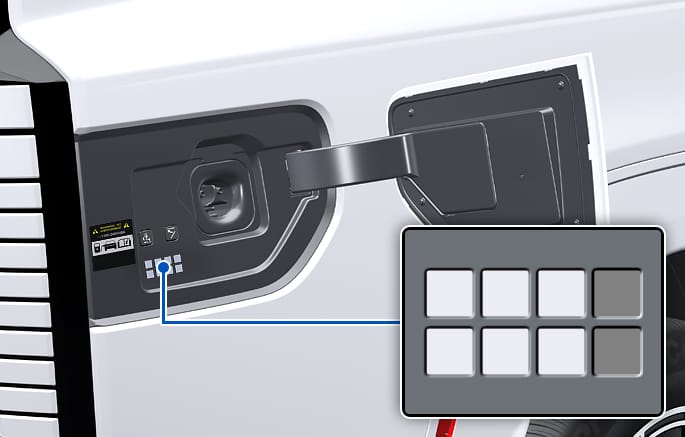
2C_ChargingDoorIndicator
Check the State of Charge (SOC) of the high voltage battery via the charge indicator light inside the charging door with the vehicle door unlocked.
-
SOC is indicated in 4 levels.
|
Charge indicator lamp |
SOC [%] |

|
0-24 % |

|
25-49 % |

|
50-74 % |

|
75-100 % |
On the instrument cluster
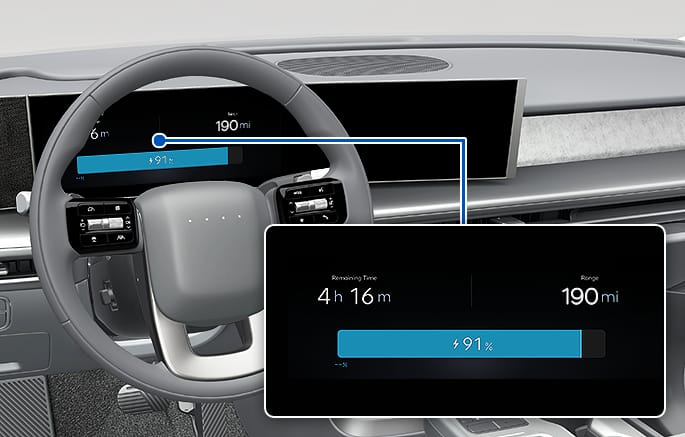
2C_ChargingLevelIndicator
Check the charging state on the instrument cluster to monitor the battery capacity of the high voltage and estimated charging time.
When charging starts, the charging state will be displayed on instrument cluster.
-
With the vehicle on, the charging state will be displayed continuously.
-
When the vehicle is off, the charging state will be displayed for up to 1 minute.
The charging state will be displayed continuously when a door is opened.
-
When scheduled charging is set, scheduled charging message is displayed.
-
When scheduled air conditioner or heater operates while waiting for the scheduled charging, the estimated charging time is displayed as "-".
Steering wheel
Check the State of Charge (SOC) of the high voltage battery via the charge indicator light middle of the steering wheel.
-
SOC is indicated in 4 levels.
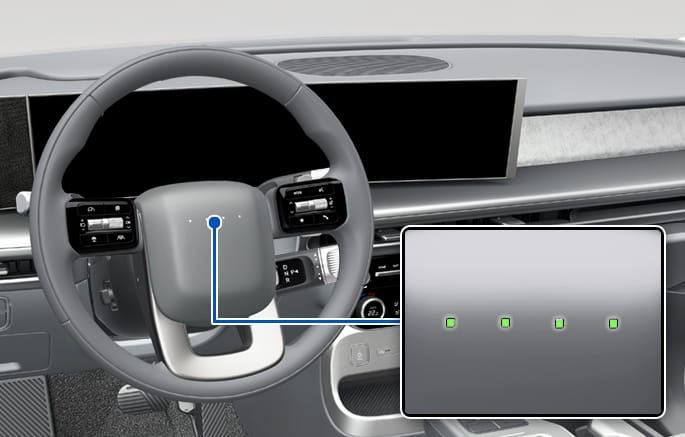
2C_FrontBumperIndicator
Charge indicator lamp
SOC [%]

0-24 %

25-49 %

50-74 %

75-100 %
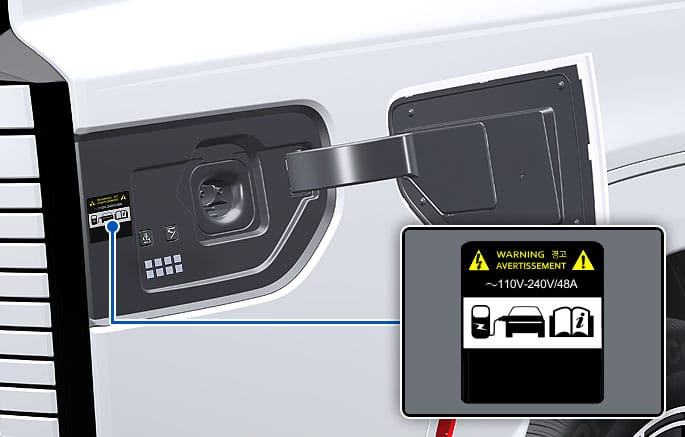
2C_ChargingLabelLocation

1C_ChargingLabel
Open the charging door and check the information on the charging label on the right side of the charging connector. The charging label shows safety symbols and the rated input specifications for charging.
|
No. |
Name |
Description |
|
1 |
Warning for high voltage |
Indicates a device with a risk of electric shock. |
|
2 |
Warning/Caution symbol |
Indicates a device that may cause property damage, serious injury or death if not operated carefully. |
|
3 |
Rated voltage and maximum charging current |
Indicates the type of input current (~, AC) and the rated voltage range (V) and charging current (A) when AC charging. |
When the charging connector is connected to the vehicle charging inlet, it is locked automatically to prevent unintended detachment from the vehicle while charging.
To remove the charging connector after charging is complete:
-
Unlock any vehicle door.
-
Push and hold down the latch on the charging connector.
If you press the latch on the charging connector while charging, charging will pause temporarily or stop completely depending on the AC/DC charging type.
-
AC charge: Charging is temporarily paused.
-
DC charge: Charging is stopped.
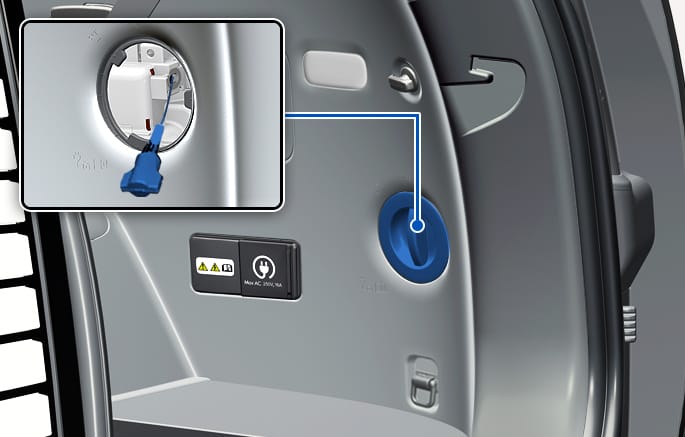
2C_EmergencyChargingCable
If the unlock button is not functioning properly due to a discharged battery or abnormal electrical wiring, the charging connector cannot be disconnected from the vehicle.
If the charging connector is not disconnected due to battery being fully discharged or a wiring failure, open the liftgate and pull the emergency cable on the liftgate's right wall. If the charging connector does not disconnect after pulling the emergency cable, have your vehicle inspected by an authorized HYUNDAI dealer.
Do not disconnect the charging connector forcibly. Doing so may damage the charging connector or the charging inlet on the vehicle.