Snow or Icy Conditions
You need to keep sufficient distance between your vehicle and the vehicle in front of you.
Apply the brakes gently. Speeding, rapid acceleration, sudden brake applications, and sharp turns are potentially very hazardous practices. Sudden brake applications on snowy or icy roads may cause the vehicle to skid.
To drive your vehicle in deep snow, it may be necessary to install tire chains on your tires.
Always carry emergency equipment. Some of the items you may want to carry include tire chains, tow straps or chains, a flashlight, emergency flares, sand, a shovel, jumper cables, a window scraper, gloves, ground cloth, coveralls, a blanket, etc.
Snow tires should be equivalent in size and type to the vehicle's standard tires. Otherwise, the safety and handling of your vehicle may be adversely affected.
Use snow tires when the road temperature is below 45 °F (7 °C). If you mount snow tires on your vehicle, be sure to use the same inflation pressure as the original tires. Mount snow tires on all four wheels to balance your vehicle's handling in all weather conditions.
The traction provided by snow tires on dry roads may not be as high as your vehicle's original equipment tires. Check with the tire dealer for maximum speed recommendations.
-
Summer tires are used to maximize the driving performance on dry roads.
-
If the temperature is below 45 °F (7 °C) or you are driving on snowy or icy roads, the summer tires lose their brake performance and traction as the tire grip weakens significantly.
-
If the temperature is below 45 °F (7 °C) or you are driving on snowy or icy roads, mount snow tires or all-season tires of the same size with your vehicle’s standard tire for safe driving. Both snow and all-season tires have M+S markings.
-
When using the M+S tires, use tires with the same tread produced by the same manufacturer for safe driving.
-
When driving with the M+S tires with the lower maximum allowable speed than that of the vehicle’s standard summer tire, be careful not to exceed the speed allowed for the M+S tires.
2C_TireChain_1
2C_TireChain
2C_TireChain_2
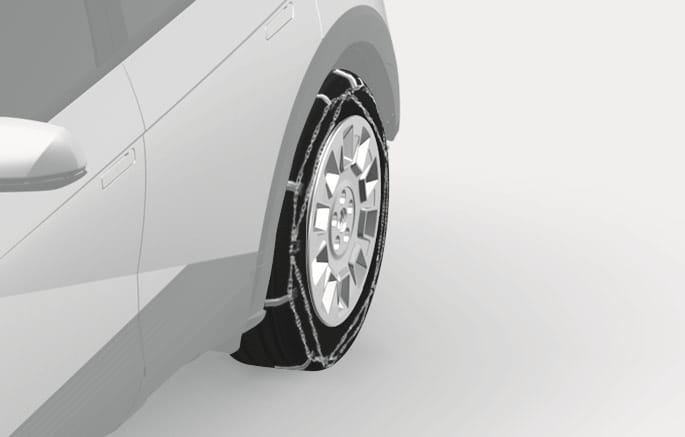
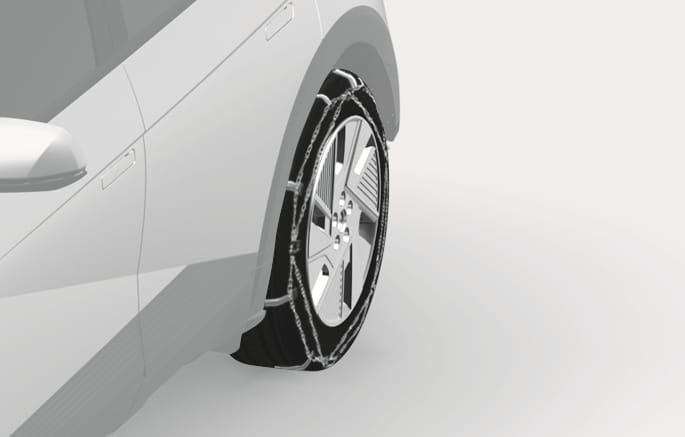
Since the sidewalls of radial tires are thinner than other types of tires, they may be damaged by mounting some types of tire chains on them. Therefore, the use of snow tires is recommended instead of tire chains.
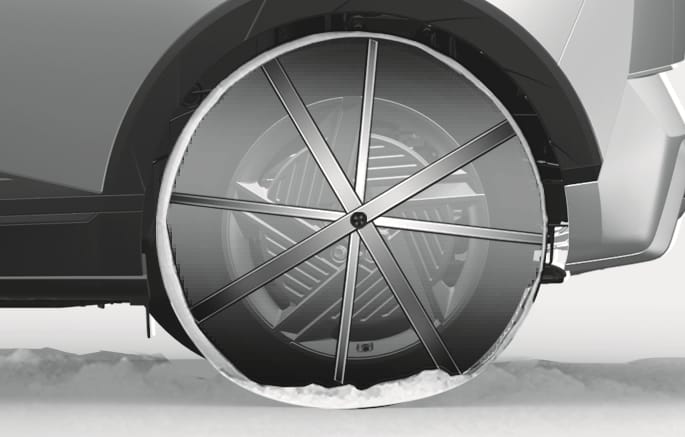
If snow snow traction aids must be used, it is recommended to use AutoSocks (fabric snow "chains").
If tire chains must be used, verify they are mounted properly and do not contact the inner fender, suspension, or rub on the surface of the wheels. Damage to your vehicle caused by improper tire chain use is not covered by your vehicle manufacturer’s warranty.
When using tire chains, install tire chains only on the rear tires.
The use of tire chains may adversely affect vehicle handling:
-
Drive less than 20 mph (30 km/h) or the chain manufacturer’s recommended speed limit, whichever is lower.
-
Drive carefully and avoid bumps, holes, sharp turns, and other road hazards, which may cause the vehicle to bounce.
-
Avoid sharp turns or locked wheel braking.
-
Install tire chains only in pairs and on the rear tires. It should be noted that installing tire chains on the tires will provide a greater driving force, but will not prevent side skids.
-
Do not install studded tires without first checking local and municipal regulations for possible restrictions against their use.
The use of AutoSock (fabric snow chain) may adversely affect vehicle handling:
-
Drive less than 20 mph (30 km/h) or the chain manufacturer’s recommended speed limit, whichever is lower.
-
Drive carefully and avoid bumps, holes, sharp turns, and other road hazards, which may cause the vehicle to bounce.
-
Avoid sharp turns or locked wheel braking.
-
Install AutoSock (fabric snow chain) only in pairs and on the rear tires. It should be noted that installing AutoSock (fabric snow chain) on the tires will provide a greater driving force, but will not prevent side skids.
-
Do not install studded tires without first checking local and municipal regulations for possible restrictions against their use.
Chain Installation
When installing tire chains, follow the manufacturer’s instructions and mount them as tightly possible. Drive slowly (less than 20 mph (30 km/h)) with chains installed. If you hear the chains contacting the body or chassis, stop and tighten them. If they still make contact, slow down until the noise stops. Remove the tire chains as soon as you begin driving on cleared roads.
When mounting snow chains, park the vehicle on level ground away from traffic. Turn on the vehicle Hazard Warning Flasher and place a triangular emergency warning device behind the vehicle (if available). Always place the vehicle in P (Park), apply the parking brake and turn off the vehicle before installing snow chains.
When using tire chains:
-
Wrong size chains or improperly installed chains can damage your vehicle’s brake lines, suspension, body and wheels.
-
Use SAE “S” class wire chains.
-
If you hear noise caused by chains contacting the body, retighten the chain to prevent contact with the vehicle body.
-
To prevent body damage, retighten the chains after driving 0.3~0.6 mi. (0.5~1.0 km).
-
Do not use traditional tire chains on vehicles equipped with aluminum wheels. If unavoidable, use a wire type chain.
-
Install tire chains that meet the specifications of each tire size to prevent damage your vehicle.
-
18 in., 19 in. tires use AutoSocks (Fabric Snow Chains) if possible, or wire chains less than 0.47 in. (12 mm).
-
20 in. tires use only AutoSocks (fabric snow chains).
-