Tires and wheels
Tire failure may cause loss of vehicle control and result in a collision. To reduce risk of serious injury or death:
-
Inspect your tires monthly for proper inflation as well as wear and damage.
-
The recommended cold tire pressure for your vehicle can be found in this manual and on the tire label located on the driver's side center pillar. Always use a tire pressure gauge to measure tire pressure. Tires with too much or too little pressure wear unevenly causing poor handling.
-
Check the pressure of the spare every time you check the pressure of the other tires on your vehicle.
-
Replace tires that are worn, show uneven wear, or are damaged. Worn tires can cause loss of braking effectiveness, steering control, or traction.
-
Always replace tires with the same size, type, construction, and tread pattern as each tire that was originally supplied with this vehicle. Using tires and wheels other than the recommended sizes may cause unusual handling characteristics, poor vehicle control, or negatively affect your vehicle's Anti-Lock Brake System (ABS) resulting in a serious accident.
For proper maintenance, safety, and maximum electric energy economy, always maintain recommended tire inflation pressures and stay within the load limits and weight distribution recommended for your vehicle.
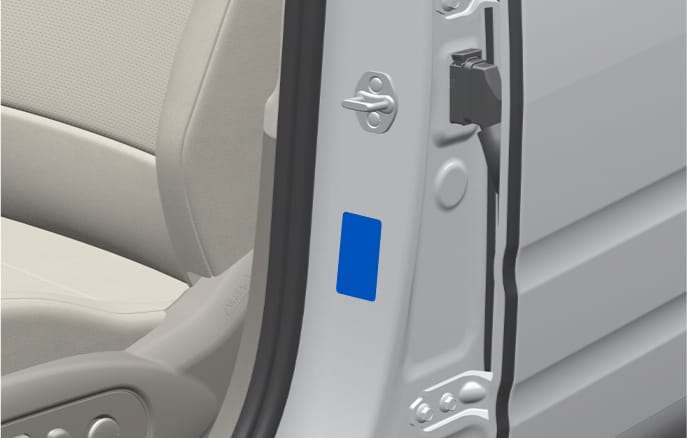
2C_TireLabel
All specifications (sizes and pressures) can be found on a label attached to the driver's side center pillar.
Check all tire pressures (including the spare) when the tires are cold. Cold tires mean the vehicle has not been driven for at least three hours or driven less than 1.6 km (1 mi.).
-
Recommended pressures must be maintained for the best ride, vehicle handling, and minimum tire wear.
-
Over-inflation or under-inflation can reduce tire life, adversely affect vehicle handling, and lead to sudden tire failure that may result in loss of vehicle control resulting in a collision.
-
Severe under-inflation may lead to severe heat build-up, causing blowouts, tread separation, and other tire failures that may result in loss of vehicle control resulting in a collision. This risk is much higher on hot days and when driving for a long time at high speeds.
-
Under-inflation may cause excessive wear, poor handling, and reduced energy efficiency. Wheel deformation is also possible. Keep your tire pressures at the proper levels. If a tire frequently needs refilling, we recommend that your vehicle be inspected by an authorized HYUNDAI dealer.
-
Over-inflation produces a harsh ride, excessive wear at the center of the tire tread, and a greater possibility of damage from road hazards.
Warm tires normally exceed the recommended cold tire pressures by 28 to 41 kPa (4 to 6 psi). Do not release air from warm tires to adjust the pressure. The tires are under-inflated. For recommended inflation pressure, refer to Tires and wheels.
This information identifies and describes the fundamental characteristics of the tire and also provides the Tire Identification Number (TIN) for safety standard certification. The TIN can be used to identify the tire in case of a recall.
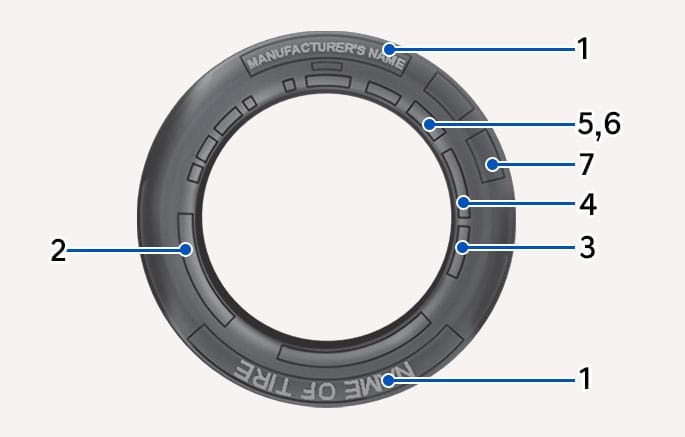
2C_TireSideWallLabelling
- Manufacturer or brand name
- Tire size designation
- Checking tire life (TIN)
- Tire ply composition and material
- Maximum permissible inflation pressure
- Maximum load rating
- Uniform tire quality grading
Manufacturer or brand name
Manufacturer or brand name is shown.
Tire size designation
A tire's sidewall is marked with a tire size designation. You need this information when selecting replacement tires for your vehicle.
Example tire size designation:
(These numbers are provided as an example only. Your tire size designator may differ depending on your vehicle.)
-
235/60/R18 103H
-
235: Tire width in millimeters.
-
60: Aspect ratio. The tire's section height as a percentage of its width.
-
R: Tire construction code (Radial).
-
18: Rim diameter in inches.
-
103: Load Index, a numerical code associated with the maximum load the tire can carry.
-
H: Speed Rating Symbol. See the speed rating chart in this section for additional information.
-
Wheel size designation
Wheels are also marked with important information that you need if you ever have to replace one.
Example wheel size designation:
-
7.5J X 18
-
7.5: Rim width in inches.
-
J: Rim contour designation.
-
18: Rim diameter in inches.
-
Tire speed ratings
The speed rating is part of the tire size designation on the sidewall of the tire. This symbol corresponds to that tire's designed maximum safe operating speed.
|
Speed Rating Symbol |
Maximum Speed |
|
S |
180 km/h (112 mph) |
|
T |
190 km/h (118 mph) |
|
H |
210 km/h (130 mph) |
|
V |
240 km/h (149 mph) |
|
W |
270 km/h (168 mph) |
|
Y |
300 km/h (186 mph) |
Checking tire life (TIN)
Any tires that are over six years old, based on the manufacturing date, (including the spare tire) must be replaced by new ones. You can find the manufacturing date on the tire sidewall (possibly on the inside of the wheel), displaying the DOT Code.
The manufacturing date is designated by the last four digits (characters) of the DOT code. The front part of the DOT shows a plant code number, tire size and tread pattern and the last four numbers indicate week and year manufactured.
Example DOT:
DOT XXXX XXXX 1525
-
15: the week of manufacture
-
25: the year of manufacture
Tire ply composition and material
The number of layers or plies of rubber-coated fabric in the tire. Tire manufacturers also must indicate the materials in the tire, which include steel, nylon, polyester, and others. The letter 'R' means radial ply construction. The letter 'D' means diagonal or bias ply construction; and the letter 'B' means belted-bias ply construction.
Maximum permissible inflation pressure
This number is the greatest amount of air pressure that should be put in the tire. Do not exceed the maximum permissible inflation pressure. Refer to the Tire and Loading Information label for recommended inflation pressure.
Maximum load rating
This number indicates the maximum load in kilograms and pounds that can be carried by the tire. When replacing the tires on the vehicle, always use a tire that has the same load rating as the factory installed tire.
Uniform tire quality grading
Quality grades can be found where applicable on the tire sidewall between tread shoulder and maximum section width.
Example tire quality grading:
TREADWEAR 200
TRACTION AA
TEMPERATURE A
Tread wear
The tread wear grade is a comparative rating based on the wear rate of the tire when tested under controlled conditions on a specified government test course. For example, a tire graded 150 would wear one-and-a-half times (1½) as well on the government course as a tire graded 100.
The relative performance of tires depends upon the actual conditions of their use, however, and may depart significantly from the norm due to variations in driving habits, service practices, and differences in road characteristics and climate.
These grades are molded on the sidewalls of passenger vehicle tires. The tires available as standard or optional equipment on your vehicle may differ depending on the grade.
Traction - AA, A, B & C
The traction grades, from highest to lowest, are AA, A, B, and C. Those grades represent the tire's ability to stop on wet pavement as measured under controlled conditions on specified government test surfaces of asphalt and concrete. A tire marked C may have poor traction performance.
The traction grade assigned to this tire is based on straight ahead braking traction tests, and does not include acceleration, cornering, hydroplaning, or peak traction characteristics.
Temperature - A, B & C
The temperature grades are A (the highest), B and C representing the tire's resistance to the generation of heat and its ability to dissipate heat when tested under controlled conditions on a specified indoor laboratory test wheel.
Sustained high temperature may cause the material of the tire to degenerate and reduce tire life, and excessive temperature may lead to sudden tire failure. Grades A and B represent higher levels of performance on the laboratory test wheel than the minimum required by law.
The temperature grade for this tire is established for a tire that is properly inflated and not overloaded. Excessive speed, under-inflation, over-inflation, or excessive loading, either separately or in combination, may cause heat build-up and possible sudden tire failure.
Check your tires at least once a month.
Use a good quality tire pressure gauge to check the tire pressure. You cannot tell if your tires are properly inflated simply by looking at them. Radial tires may look properly inflated when they are underinflated.
How to check
-
Remove the valve cap from the tire valve stem.
-
Press the tire gauge firmly onto the valve to get a pressure measurement.
-
If the cold tire inflation pressure matches the recommended pressure on the tire and loading information label, no further adjustment is necessary.
-
If the pressure is low, add air until it reaches the recommended pressure.
-
If you overfill the tire, release air by pushing on the metal stem in the center of the tire valve. Recheck the tire pressure with the tire gauge.
-
-
Be sure to put the valve caps back on the valve stems. Without the valve cap, dirt or moisture may get into the valve core and cause air leakage. If a valve cap is missing, install a new one as soon as possible.
The wheels on your vehicle were aligned and balanced carefully at the factory, and you may not need to have your wheels aligned again. If you notice unusual tire wear or your vehicle pulling to one side, the alignment may need to be adjusted.
If you notice your vehicle vibrating when driving on a smooth road, your wheels may need to be rebalanced.
Only use approved wheel weights or your vehicle's aluminum wheels may be damaged.
When removing and installing wheels and tires, use the dedicated remover inside the tool case to remove the wheel cover.
The remover hole is located at the top or edge of the wheel cover.
Remover storage position
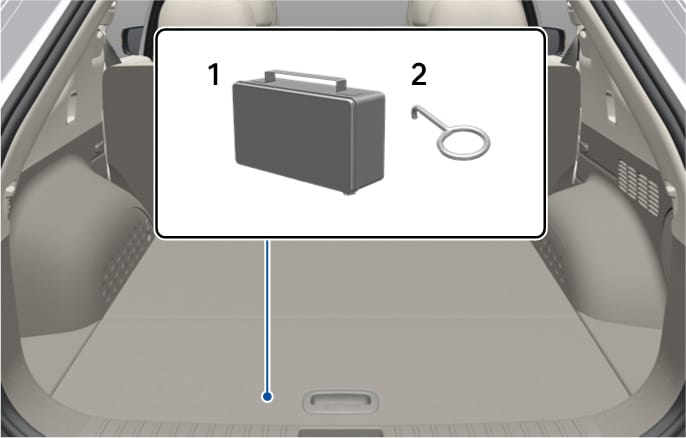
2C_WheelRemover
- Tool case
- Remover
Removing/Installing the wheel cover using the remover
Using the remover in the tool case to remove the wheel cover.
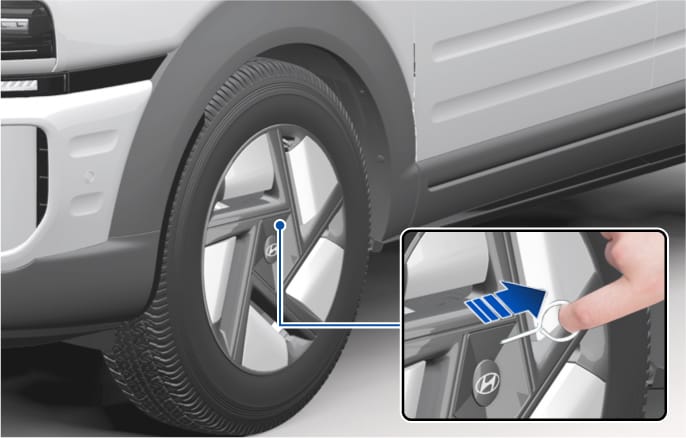
2C_WheelCover
Align the position of the remover hole and the air inlet as shown in the picture below and install the wheel cover.
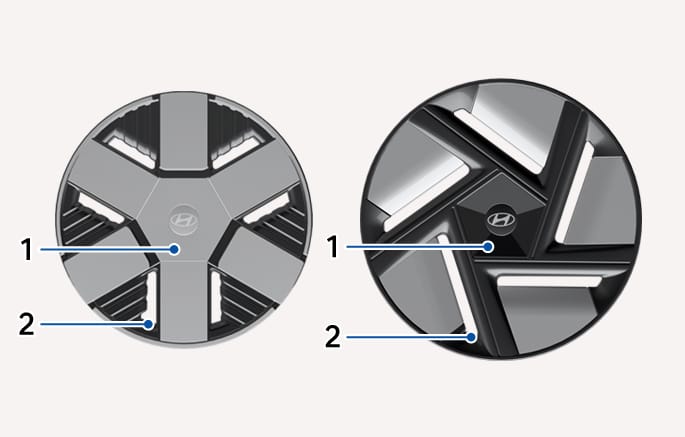
2C_WheelCover_1
- Remover hole
- Air inlet
-
Make sure to mount the wheel cover on the designated position when installing the wheel cover.
-
The designated position of the wheel cover depends on the shape of the wheel.
To equalize tread wear, HYUNDAI recommends that the tires be rotated every 10,000 km (6,000 mi.) or sooner if irregular wear develops.
During rotation, check the tires for correct balance.
When rotating tires, check for uneven wear and damage. Abnormal wear is usually caused by incorrect tire pressure, improper wheel alignment, out-of-balance wheels, severe braking, or severe cornering. Look for bumps or bulges in the tread or side of the tire. Replace the tire if you find any of these conditions. Replace the tire if fabric or cord is visible. After rotation, be sure to bring the front and rear tire pressures to specification and check nut torque (proper torque is 11-13 kgf·m (79-94 lbf·ft)).
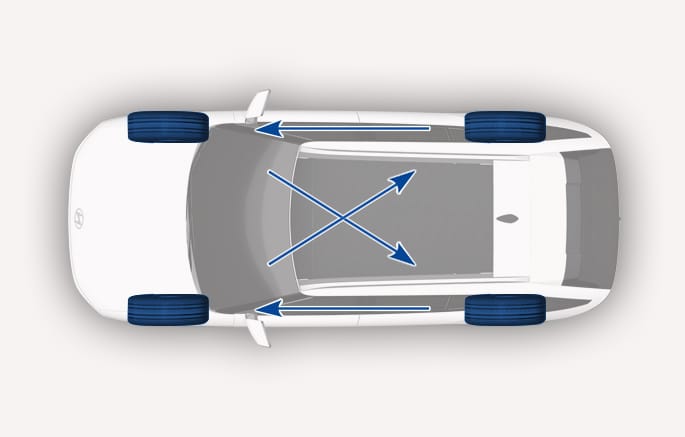
2C_TireRotation
Disc brake pads should be inspected for wear whenever tires are rotated.
-
Do not use the compact spare tire for tire rotation.
-
Do not mix bias ply and radial ply tires under any circumstances. This may cause unusual handling characteristics that may cause loss of vehicle control and result in a collision.
When installing an unsymmetrical tire, install the side marked outside facing out.
In addition to proper inflation, correct wheel alignment helps decrease the tire wear. If you find a tire is worn unevenly, have your dealer check the wheel alignment. When you have new tires installed, make sure they are balanced. This may increase ride comfort and tire life. Additionally, a tire must always be rebalanced if it is removed from the wheel.
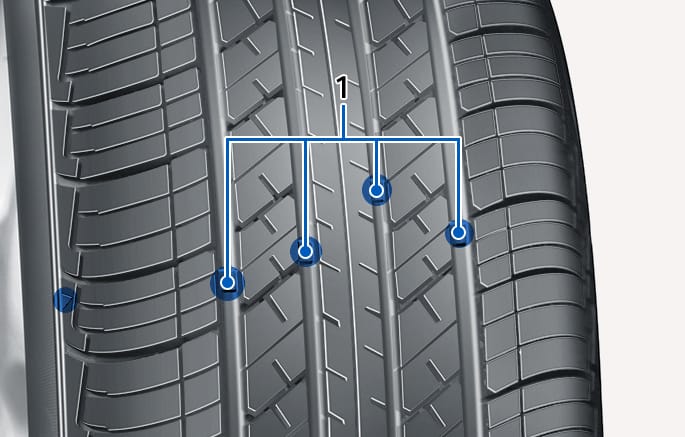
2C_TireWareIndicator
- Tread wear indicator
If the tire is worn evenly, a tread wear indicator appears as a solid band across the tread. This shows there is less than 1.6 mm (1/16 in.) of tread left on the tire. Replace the tire when this happens.
Do not wait for the band to appear across the entire tread before replacing the tire.
Tire traction
Tire traction can be reduced if you drive on worn tires or the tires that are improperly inflated, or on slippery road surfaces. Replace the tires when tread wear indicators appear. To reduce the possibility of losing control, slow down whenever there is rain, snow, or ice on the road.
To reduce the risk of death or serious injury:
-
Replace tires that are worn, show uneven wear, or are damaged. Worn tires may cause loss of braking effectiveness, steering control, and traction.
-
Always replace tires with the same size as each tire that was originally supplied with this vehicle. Using tires and wheels other than the recommended sizes may cause unusual handling characteristics, poor vehicle control, or negatively affect your vehicle's Anti-Lock Brake System (ABS).
-
When replacing tires (or wheels), it is recommended to replace the two front or two rear tires (or wheels) as a pair. Replacing just one tire may seriously affect your vehicle's handling.
-
Tires degrade over time, even when they are not being used. Regardless of the remaining tread, HYUNDAI recommends that tires be replaced after 6 years of normal service.
-
Driving in hot climates or excessive loading may accelerate the tire aging process.
When replacing the metal wheels for any reason, make sure the new wheels are equivalent to the original factory units in diameter, rim width, and offset.
The aspect ratio is lower than 50 on low aspect ratio tires.
Because low aspect ratio tires are optimized for handling and braking, their sidewall is a little stiffer than a standard tire. Also low aspect ratio tires tend to be wider and consequently have a greater contact patch with the road surface. In some instances they may generate more road noise compared with standard tires.
Low aspect wheels and tires are easily damaged. To reduce the risk of damage:
-
When driving on rough roads, passing over a pothole, speed bump, manhole, or curb stone, drive the vehicle slowly not to damage the tires and wheels. Damage is not covered by your vehicle warranty.
-
Inspect the tire condition and pressure every 3,000 km (1,800 miles).
-
It is difficult to visually inspect for tire damage with your eyes. If any damage is found, we recommend that you contact an authorized HYUNDAI dealer to replace the tire.