4WD operation
|
Transfer mode |
Selection button |
Indicator light |
Description |
|
4WD AUTO (4WD LOCK is deactivated) |
|
|
|
|
4WD LOCK |

|
|
|
If 4WD warning light (
When driving on normal roads, deactivate the 4WD LOCK mode by pushing the 4WD LOCK button (4WD LOCK indicator light goes off). Driving on normal roads with the 4WD LOCK mode, especially, when cornering may cause mechanical noise or vibration. The noise and vibration will disappear when the 4WD LOCK mode is deactivated. Prolong driving with the noise and vibration may damage some parts of the power train.
-
Maintain 4WD Auto mode when driving on roads in normal conditions.
-
When driving under normal road conditions (especially when cornering) in 4WD Lock mode, a driver may find minor mechanical vibration or noise, which is extremely normal phenomenon, not a malfunction. When 4WD Lock mode is released, such noise or vibration will be immediately gone.
When the 4WD LOCK mode is deactivated, a sensation may be felt as the driving power is delivered entirely to the front wheels.
Before driving
-
Make sure all passengers are wearing seat belts.
-
Sit upright and closer to the steering wheel than usual. Adjust the steering wheel to a position comfortable for you to drive.
Driving on snow-covered or icy roads
-
Start off slowly by applying the accelerator pedal gently.
-
Use snow tires or tire chains.
-
Keep sufficient distance between your vehicle and the vehicle in front of you.
-
Use engine braking during deceleration.
-
Avoid speeding, rapid acceleration, sudden brake applications, and sharp turns to prevent skids.
Driving in sand or mud
-
Maintain slow and constant speed.
-
Use tire chains driving in mud if necessary.
-
Keep sufficient distance between your vehicle and the vehicle in front of you.
-
Reduce vehicle speed and always check the road condition.
-
Avoid speeding, rapid acceleration, sudden brake applications, and sharp turns to prevent getting stuck.
When the vehicle is stuck in snow, sand or mud, place a non-slip material under the drive wheels to provide traction OR Slowly spin the wheels in forward and reverse directions which causes a rocking motion that may free the vehicle. However, avoid running the engine continuously at high RPM, doing so may damage the 4WD system.
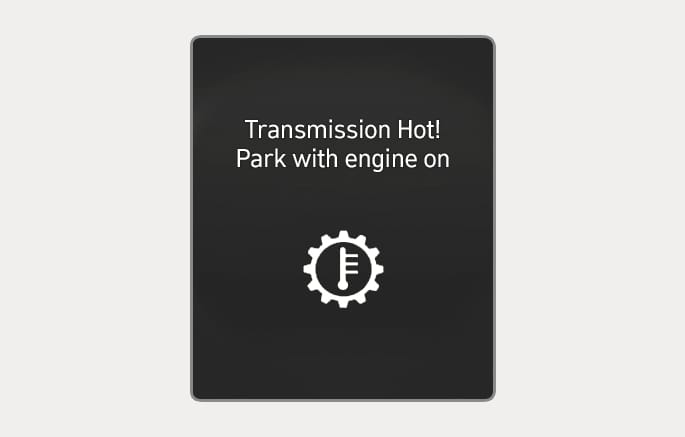
2C_ShiftOverheatStopVehicleInfo
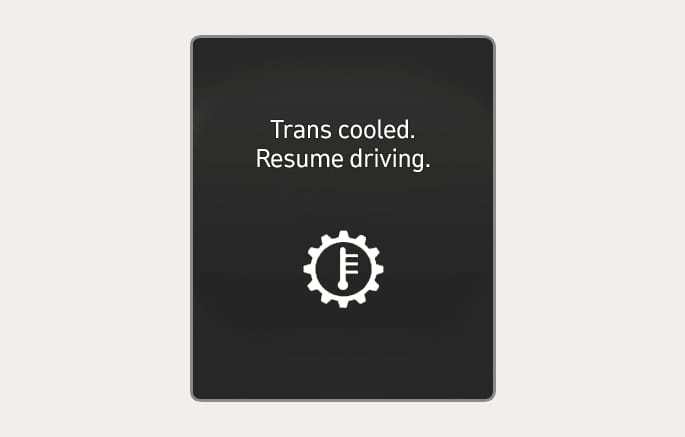
2C_ShiftOverheatCanDriveInfo
Transmission overheated
-
When driving on muddy and sandy roads under the severe condition, the transmission could be overheated.
-
When the transmission is overheated, the safe protection mode engages and the "Transmission Hot! Park with engine on: warning message will appear on the cluster display with a chime.
-
If this occurs, pull over to a safe location, stop the vehicle with the engine running, apply the brakes and shift the vehicle to P (Park), and allow the transmission to cool.
-
If you ignore this warning, the driving condition may become worse. You may experience abrupt shifts, frequent shifts, or jerkiness. To return to the normal driving condition, stop the vehicle and apply the foot brake or shift into P (Park). Then allow the transmission to cool for a few minutes with engine on, before driving off.
-
When the message "Trans cooled. Resume driving" appears you can continue to drive your vehicle.
-
If the warning messages in the cluster display continue to blink, for your safety, we recommend that the system be checked by an authorized HYUNDAI dealer.
Driving up or down hills
-
Driving uphill
-
Before starting off, check if it is possible to drive uphill.
-
Drive as straight as possible.
-
-
Driving downhill
-
Do not change gears while driving downhill. Select a gear before driving downhill.
-
Drive slowly when using engine braking while driving downhill.
-
Drive straight as possible.
-
-
Exercise extreme caution driving up or down steep hills. The vehicle may roll over in the grade, terrain, and water/ mud conditions.
-
Do not drive across steep hills. A slight change in the wheel angle may destabilize the vehicle. A stable vehicle may lose stability if the vehicle stops its forward motion. Your vehicle may roll over, resulting in a serious injury or death.
Driving through water
-
Try to avoid driving in deep standing water. It may stall your engine and clog your exhaust pipes.
-
Do not change gears while driving in water.
Additional driving conditions
-
Become familiar with the off-road conditions before driving.
-
Always pay attention when driving off-road and avoid dangerous areas.
-
Drive slowly when driving in heavy wind.
-
Reduce vehicle speed when cornering. The center of gravity of 4WD vehicles is higher than conventional 2WD vehicles. The vehicle is more likely to roll over if you turn the steering wheel too quickly.
-
Always hold the steering wheel firmly when you are driving off-road.
Do not grab the inside of the steering wheel when you are driving off-road. You may hurt your arm by a sudden steering maneuver or from steering wheel rebound due to an impact with objects on the ground. You may lose control of the steering wheel that may lead to serious injury or death.