Forward Collision-Avoidance Assist (FCA) (Sensor fusion)
Basic function
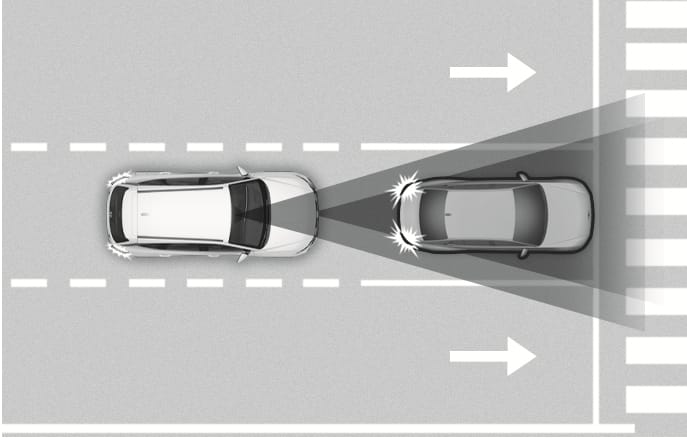
2C_FCABasicFunction
Forward Collision-Avoidance Assist is designed to help detect and monitor the vehicle ahead or help detect a powered two-wheeler, pedestrian or cyclist in the roadway and warn the driver that a collision is imminent with a warning message and warning and apply emergency braking.
Junction Turning function
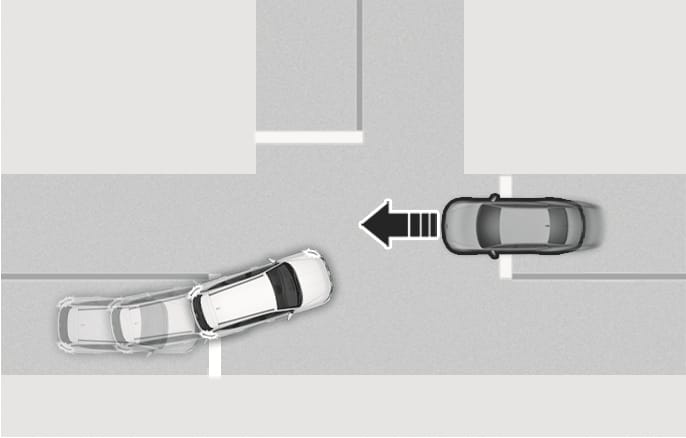
2C_FCAJunctionTurningFunction
Junction Turning function can help avoid a collision with an oncoming vehicle in an adjacent lane when turning left (left-hand drive) or right (right-hand drive) at a crossroad with the turn signal on by applying emergency braking.
Direct Oncoming function
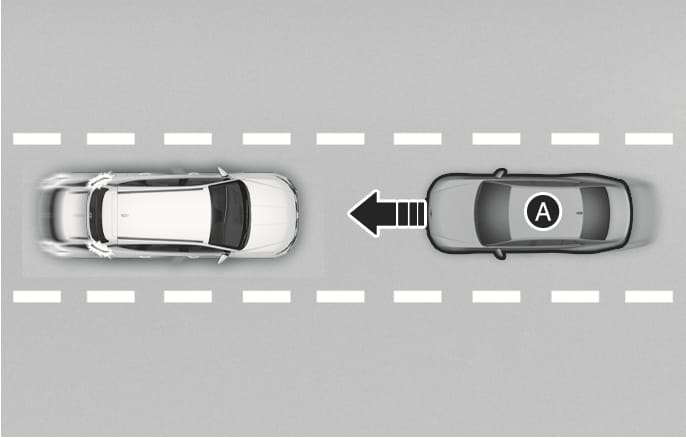
2C_FCADirectOncomingFunction
- Oncoming vehicle
Direct Oncoming function helps reduce the speed at the collision when a vehicle approaching from the opposite side is detected.
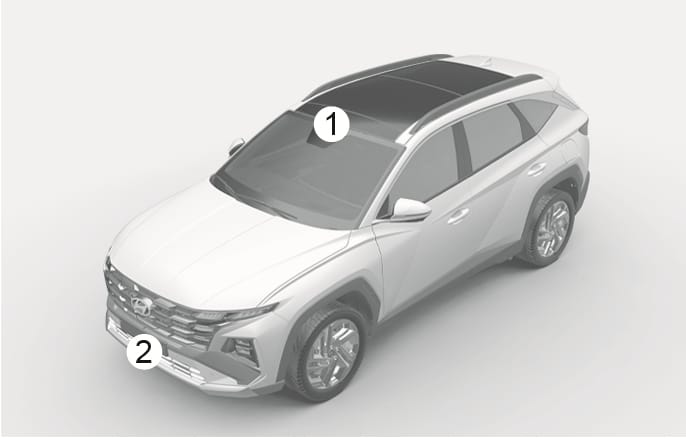
2C_FrontViewCamera
- Front view camera
- Front radar
Refer to the picture above for the detailed location of the detecting sensors.
Take the following precautions to maintain optimal performance of the detecting sensor:
-
Never disassemble the detecting sensor or sensor assembly, or cause any damage to it.
-
If the detecting sensors have been replaced or repaired, we recommend that you have your vehicle inspected by an authorized HYUNDAI dealer.
-
Never install any accessories or stickers on the front windshield, or tint the front windshield.
-
Pay extreme caution to keep the front view camera dry.
-
Never place any reflective objects (for example, white paper, mirror) over the dashboard.
-
Do not place any objects near the front windshield or install any accessories on the front windshield. It can affect the performance of the defogging and defrosting function of the climate control system, which may prevent the Driver Assistance systems from operating.
-
Do not apply license plate frame or objects, such as a bumper sticker, film or a bumper guard, near the front radar cover.
-
Always keep the front radar and cover clean and free of dirt and debris.
Use only a soft cloth to wash the vehicle. Do not spray pressurized water directly on the sensor or sensor cover.
-
If the radar or the area around the radar has been damaged or impacted in any way, Forward Collision-Avoidance Assist may not properly operate even though a warning message does not appear on the cluster. We recommend that your vehicle be inspected by an authorized HYUNDAI dealer.
-
Use only genuine parts to repair or replace a damaged front radar cover. Do not apply paint to the front radar cover.