Smart key
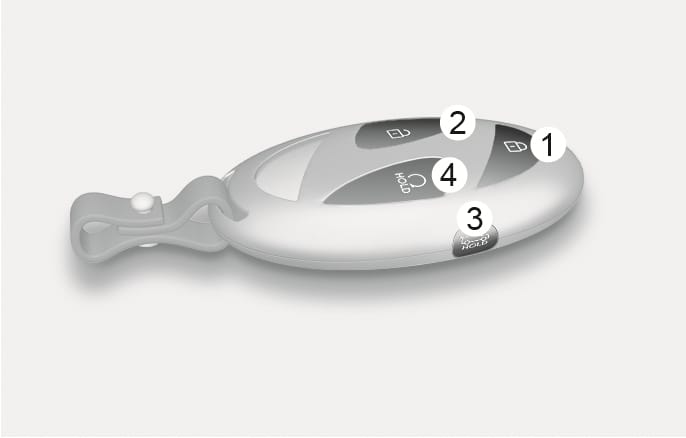
2C_SmartKeyOverview
Your HYUNDAI uses a smart key, which you can use to lock or unlock a door (and tailgate) and even start the engine even just carrying the key.
-
Door lock
-
Door unlock
-
Tailgate lock / unlock (Tailgate)
Tailgate open / close (Power tailgate)
-
Remote start (if equipped)
Button type
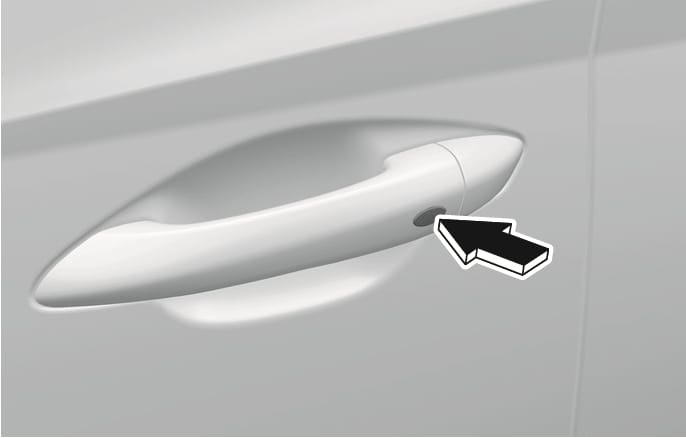
2C_OutsideDoorHandleButton
To lock :
-
Close all doors, engine hood and tailgate.
-
Carry the smart key.
-
Either press the door handle button or press the Door Lock button on the smart key.
-
The hazard warning lights will blink. Also, the outside rearview mirror will fold, if 'Convenience > Welcome mirror/light > On door unlock or On driver approach' is selected from the User Settings mode on the cluster display. For more details, refer to "Cluster display" in chapter 4.
-
Make sure the doors are locked by pulling the door outside handle.
Do not leave the Smart Key in your vehicle with children that are unattended or unsupervised.
Children could unintentionally press the Engine Start/Stop button or could operate the power windows or other vehicle controls or even cause the vehicle to move. This may result in serious injury or death.
Button type
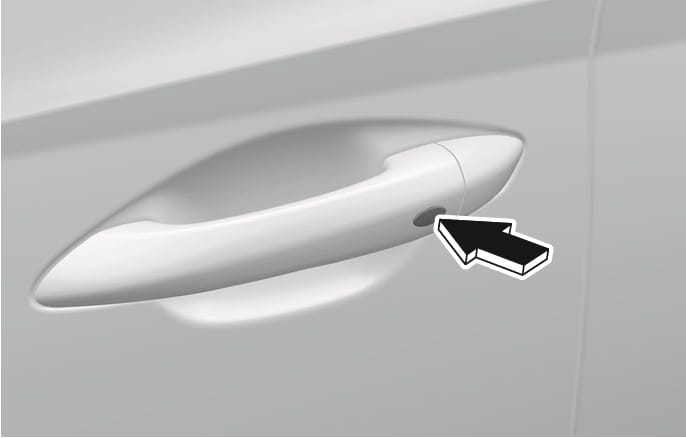
2C_OutsideDoorHandleBottonWithHand
-
Have the smart key with you.
-
Press the door handle button or press the Door Unlock button (2) on the smart key.
-
The hazard warning lights blink. Also, the outside rearview mirrors unfold if Settings > Vehicle > Lights > Welcome mirror/light > On door unlock or On driver approach is selected from the infotainment system.
To unlock:
-
Carry the smart key.
-
Either press the tailgate handle button or press the Tailgate Unlock button (3) on the smart key for more than one second.
-
The hazard warning lights will blink two times.
-
The Tailgate Unlock button (3) will only unlock the tailgate. It will not release the latch and open the tailgate automatically. If the Tailgate Unlock button is used, someone must still press the tailgate handle button to open the tailgate.
-
After unlocking the tailgate, the tailgate will lock automatically after 30 seconds unless the tailgate is opened.
To start the vehicle remotely:
-
Press the door lock button (1) on the smart key within about 10 m (32 ft.) from the vehicle.
-
Press the Remote Start button (4) on the smart key within 2 seconds from when you have pressed the door lock button. The engine starts.
-
To turn off the engine, press the Remote Start button (4) once.
-
The vehicle must be in P (Park) for the remote start function to start.
-
The vehicle displays 'Smart Key must be present to keep the vehicle running' if you get on the vehicle without a registered smart key.
-
The vehicle turns off if you do not get in the vehicle within 10 minutes after remotely starting the vehicle.
-
The Remote Start button (4) may not operate if the smart key is not within 10 m (32 ft.) from the vehicle.
-
The vehicle does not remotely start if the hood or tailgate is open.
-
Do not idle the engine for a long time.
Some models are equipped with a Engine Start/Stop button instead of a key cylinder. You can leave your smart key in your pocket or purse when you start your vehicle. For more information, refer to the "Ignition switch" section in chapter 6.
To prevent damaging the smart key:
-
Keep the smart key in a cool, dry place to avoid damage or malfunction. Exposure to moisture or high temperature may cause the internal circuit of the smart key to malfunction. This may not be covered under warranty.
-
Avoid dropping or throwing the smart key.
-
Protect the smart key from extreme temperatures.
If the smart key is not moved for some time, the detection function for smart key operation will pause. Lift the smart key to activate the detection again.
The smart key may not work if any of the following occur:
-
The smart key is close to a radio transmitter such as radio station or airport that may interfere with normal operation of the transmitter.
-
The smart key is near a mobile two way radio system or a mobile phone.
-
Another vehicle's smart key is being operated close to your vehicle.
-
The smart key is near any normal electronic devices or credit cards.
-
The vehicle battery is discharged.
-
Connecting an external device to the power outlet and placing the smart key near the external device.
-
If your windows are tinted, especially with metallic window tint, it may cause frequency interference, reducing the smart key operating range.
-
Make sure the smart key battery is inserted in the correct polarity before use. Using an improperly positioned battery may cause smart key failure or premature discharge of the battery.
If the smart key does not work correctly, open and close the door with the mechanical key. To start the engine, press the Engine Start/Stop button directly with the smart key. If you have a problem with the smart key, it is recommended to contact an authorized HYUNDAI dealer.
If the smart key is in close proximity to your mobile phone, the signal could be blocked by your mobile phone's normal operational signals. This is specifically relevant when the phone is active such as making and receiving calls, text messaging, and/or sending/receiving emails. When possible, avoid keeping the smart key and your mobile phone in the same location such as a pants or jacket pocket to avoid interference between the two devices.
-
Keep the smart key away from electromagnetic materials that blocks electromagnetic waves to the key surface.
-
Always have the smart key with you when leaving the vehicle. If the smart key is left near the vehicle, the vehicle battery may be discharged.
Battery type: CR2450
To replace the battery:
-
Insert a slim tool into the slot (1) and gently open the rear cover.
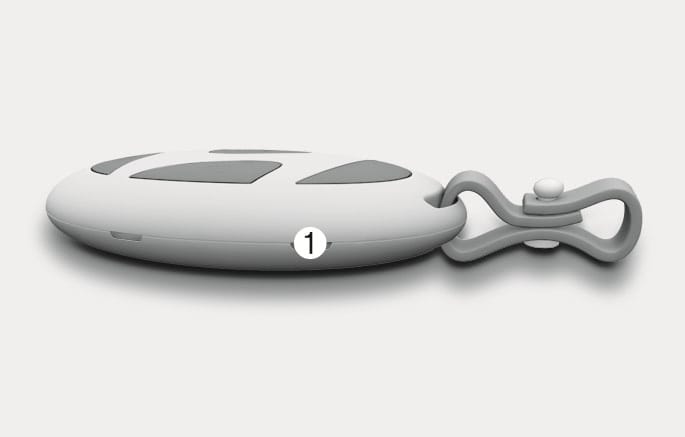
2C_RemoveSmartKeyCover
-
Remove the old battery and insert a new battery. Make sure the battery position is correct. An improperly positioned battery may discharge the battery, causing smart key failure.
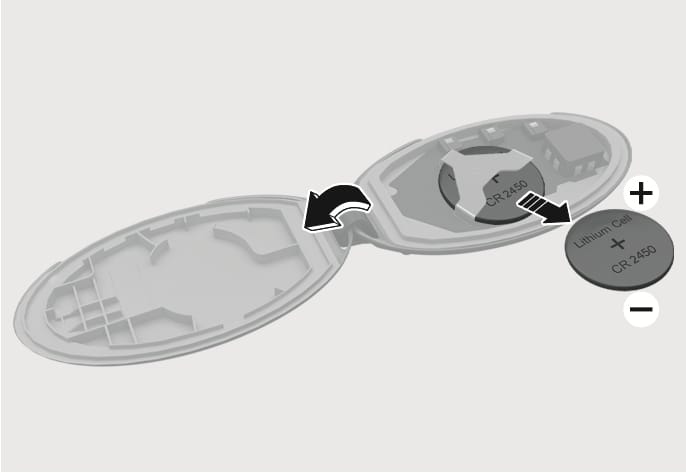
2C_ReplaceSmartKeyBattery
-
Reinstall the rear cover of the smart key.
If you suspect your smart key might have sustained some damage or you feel your smart key is not working correctly, we recommended that you contact an authorized HYUNDAI dealer.
This product contains a button battery.
If swallowed, a lithium button battery can cause severe or fatal injuries within 2 hours. Keep batteries out of reach of children.
If you think batteries may have been swallowed or placed inside any part of the body, seek immediate medical attention.
An inappropriately disposed battery may be harmful to the environment and human health. Always dispose of a used battery according to your local law(s) and regulations.