Key ignition switch
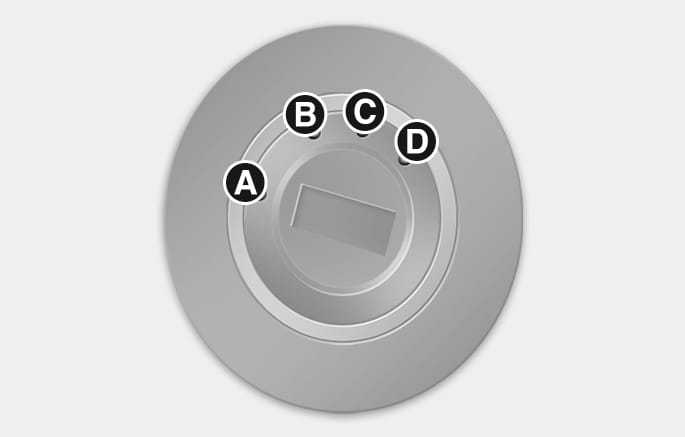
2C_Ignitionswitch
- LOCK
- ACC
- ON
- START
Whenever the front door is opened, the ignition switch will illuminate, provided the ignition switch is not in the ON position. The light will go off immediately when the ignition switch is turned on or go off after about 30 seconds when the door is closed. (if equipped)
-
NEVER turn the ignition switch to the LOCK or ACC position while the vehicle is in motion except in an emergency.
This will result in the engine turning off and loss of power assist for the steering and brake systems. This may lead to loss of directional control and braking function, which could cause an accident.
-
Before leaving the driver's seat, always make sure the vehicle is in the 1st gear (for manual transmission) or P (Park) gear (for automatic transmission/dual clutch transmission vehicle), apply the parking brake, and turn the ignition switch to the LOCK position.
Unexpected vehicle movement may occur if these precautions are not followed.
Never use aftermarket keyhole covers. This may generate start-up failure due to communication failure.
|
Switch Position |
Action |
Notes |
|
LOCK |
To turn the ignition switch to the LOCK position, push the key in at the ACC position and turn the key towards the LOCK position. The ignition key can be removed in the LOCK position. The steering wheel locks to protect the vehicle from theft. (if equipped) |
|
|
ACC |
Some electrical accessories are usable. The steering wheel unlocks. |
If difficulty is experienced turning the ignition switch to the ACC position, turn the key while turning the steering wheel right and left to release. |
|
ON |
This is the normal key position when the engine has started. All features and accessories are usable. The warning lights can be checked when you turn the ignition switch from ACC to ON. |
Do not leave the ignition switch in the ON position when the engine is not running to prevent the battery from discharging. |
|
START |
To start the engine, turn the ignition switch to the START position. The switch returns to the ON position when you let go of the key. |
The engine will crank until you release the key. |
-
Always wear appropriate shoes when operating your vehicle. Unsuitable shoes, such as high heels, ski boots, sandals, flip-flops, etc., may interfere with your ability to use the brake, accelerator and clutch pedals.
-
Do not start the vehicle with the accelerator pedal depressed. The vehicle can move which can lead to an accident.
-
Wait until the engine rpm is normal. The vehicle may suddenly move if the brake pedal is released when the rpm is high.
Starting the gasoline engine
Vehicle with Manual transmission :
-
Make sure the parking brake is applied.
-
Make sure the shift lever is in N (Neutral).
-
Depress the clutch and brake pedals.
-
Turn the ignition switch to the START position. Hold the key (maximum of 10 seconds) until the engine starts and release it.
Vehicle with Automatic transmission/ Dual clutch transmission:
-
Make sure the parking brake is applied.
-
Make sure the gear is shifted to P (Park).
-
Depress the brake pedal.
-
Turn the ignition switch to the START position. Hold the key (maximum of 10 seconds) until the engine starts and release it.
To prevent damage to the vehicle:
-
Do not hold the ignition key in the START position for more than 10 seconds. Wait 5 to 10 seconds before trying again.
-
Do not turn the ignition switch to the START position with the engine running. It may damage the starter.
-
If traffic and road conditions permit, you may put the gear in N (Neutral) while the vehicle is still moving and turn the ignition switch to the START position in an attempt to restart the engine.
-
Do not push or tow your vehicle to start the engine.
-
Do not wait for the engine to warm up while the vehicle remains stationary.
Start driving at moderate engine speeds. (Steep accelerating and decelerating should be avoided.)
-
Always start the vehicle with your foot on the brake pedal. Do not depress the accelerator while starting the vehicle. Do not race the engine while warming it up.
Starting the diesel engine
To start the diesel engine when the engine is cold, it has to be pre-heated before starting the engine and then have to be warmed up before starting to drive.
Vehicle with Manual transmission :
-
Make sure the parking brake is applied.
-
Make sure the shift lever is in P (Park).
-
Depress the brake pedal.
-
Turn the ignition switch to the ON position to pre-heat the engine. The glow indicator light (
s ) will illuminate. -
When the glow indicator light (
s ) goes out, turn the key ignition switch to the START position. Hold the key (maximum of 10 seconds) until the engine starts and release it.
Vehicle with Automatic transmission/Dual clutch transmission :
-
Make sure the parking brake is applied.
-
Make sure the gear is shifted to P (Park).
-
Depress the brake pedal.
-
Turn the ignition switch to the ON position to pre-heat the engine. The glow indicator light (
s ) will illuminate. -
When the glow indicator light (
s ) goes out, turn the key ignition switch to the START position. Hold the key (maximum of 10 seconds) until the engine starts and release it.
If the engine does not start within 10 seconds after preheating is completed, turn the ignition switch once more to the LOCK position and wait for 10 seconds. Then turn the ignition switch to the ON position in order to preheat the engine again.
Starting and stopping the engine for turbocharger intercooler
-
Do not race or accelerate the engine immediately after starting the engine.
If the engine is cold, idle for several seconds before sufficient lubrication is ensured in the turbo charger unit.
-
After high speed or extended driving that requires heavy engine load, idle the engine about 1 minute before turning the engine off.
This idle time will allow the turbocharger to cool prior to shutting the engine off.
Do not turn off the engine immediately after it has been subjected to a heavy load. Doing so may cause severe damage to the engine or turbo charger unit.
To prevent damage to the vehicle:
-
Do not hold the ignition key in the START position for more than 10 seconds. Wait 5 to 10 seconds before trying again.
-
Do not turn the ignition switch to the START position with the engine running. It may damage the starter.
-
If traffic and road conditions permit, you may put the gear in N (Neutral) while the vehicle is still moving and turn the ignition switch to the START position in an attempt to restart the engine.
-
Do not push or tow your vehicle to start the engine.