Jump starting
In the event vehicle still does not have a functional 12 V battery (check if interior lights will not turn on) then you can try a jump start to the engine compartment jumper terminals using a 12 V booster pack or jumper cables from another vehicle's 12 V battery according to the following instructions.
Jump starting can be dangerous if done incorrectly. Follow the jump starting procedure in this section to avoid serious injury or damage to your vehicle. If in doubt about how to properly jump start your vehicle, we strongly recommend that you have a service technician or towing service do it for you.
-
Position the vehicles close enough that the jumper cables will reach, but do not allow the vehicles to touch.
Avoid fans or any moving parts in the engine compartment at all times, even when the vehicles are turned off.
-
Turn off all electrical devices such as radios, lights, air conditioning, etc. Put the vehicles in P (Park) and set the parking brake. Turn both vehicles OFF.
Before jump starting, make sure to correctly identify the positive (+) and negative (-) terminals to avoid reverse polarity connections.
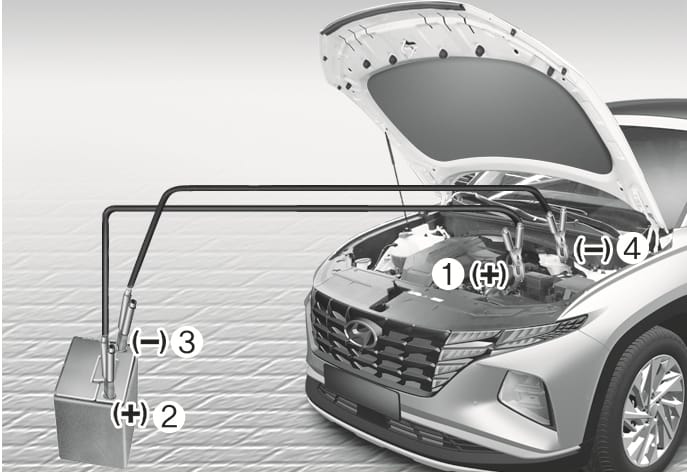
2C_JumpStartOverview
-
Connect the jumper cables in the exact sequence shown in the illustration. First connect one jumper cable to the red, positive (+) jumper terminal of your vehicle (1).
-
Connect the other end of the jumper cable to the red, positive (+) battery/jumper terminal of the assisting vehicle (2).
-
Connect the second jumper cable to the black, negative (-) battery/jumper terminal of the assisting vehicle (3).
-
Connect the other end of the second jumper cable to the black, negative (-) chassis ground of your vehicle (4).
Do not allow the jumper cables to contact anything except the correct battery or jumper terminals or the correct ground. Do not lean over the battery when making connections.
Do not connect the jumper cable to the negative (-) jumper terminal of the discharged battery. A spark could cause the battery to explode and lead to a personal injury or vehicle damage.
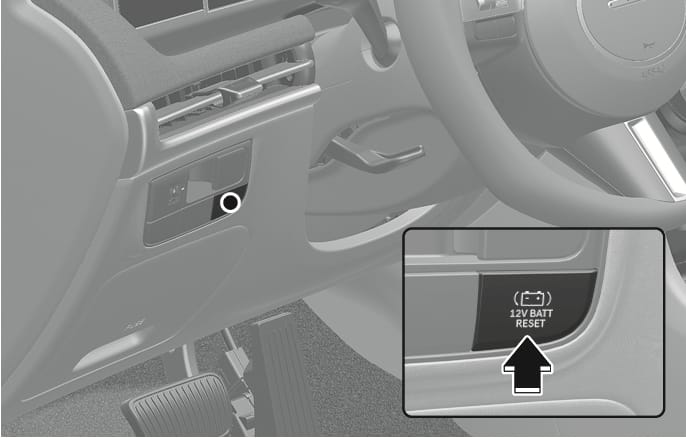
2C_12VBatteryReset
-
Press the 12 V Battery Reset switch.
-
Start the engine of the assisting vehicle and let it run for a few minutes.
-
Start your vehicle as soon as possible. After starting the vehicle (
© indicator on), operate the vehicle safely outdoors in ready mode stopped and/or drive it for 30 minutes total to charge the 12 V battery fully.
If your vehicle will not start after a few attempts, it probably requires service. In this event please seek qualified assistance. If the cause of your battery discharging is not apparent, we recommend that you have your vehicle checked by an authorized HYUNDAI dealer.
Disconnect the jumper cables in the exact reverse order you connected them:
-
Disconnect the jumper cable from the black, negative (-) chassis ground of your vehicle (4).
-
Disconnect the other end of the jumper cable from the black, negative (-) battery/chassis ground of the assisting vehicle (3).
-
Disconnect the second jumper cable from the red, positive (+) battery/jumper terminal of the assisting vehicle (2).
-
Disconnect the other end of the jumper cable from the red, charging terminal inside the engine compartment fuse panel (1).
While jump starting your vehicle, avoid coming into contact with the positive (+) and negative (-) cables. A spark could cause personal injury.
-
The use of an improper charger with a voltage and current range higher than specified may cause overheating and damage to the 12 V battery.
-
The use of an incorrect charger will lead to a power shut-off to save the 12 V battery. Stop using the incorrect charger once the power of the vehicle is shut off.
Do not jump start another vehicle with your hybrid vehicle. Jump starting another vehicle will damage the hybrid vehicle's 12 volt battery (lithium type).
To prevent damage to your vehicle:
-
Only use a 12 V power supply (battery or jumper system) to jump start your vehicle.
-
Do not attempt to jump start your vehicle by push-starting.
The voltage range of the charger should be 13.3~14 V and its current range should be less than 60 A. (13.8 V is recommended).
An inappropriately disposed battery can be harmful to the environment and human health. Dispose of the battery according to your local law(s) or regulations.