If you decide to pull a trailer
-
Consider using a sway control. You can ask a trailer hitch dealer about sway control.
-
Hyundai recommends that you do not tow with your vehicle for the first 1,200 miles (2,000 km) to allow the engine to properly break in.
-
Do not exceed 65 mph (104 km/h) or the posted towing speed limit, whichever is lower, when towing a trailer. Note that towing speed limits differ by state. Always be aware of the posted towing speed limit.
-
Trailer instability is more likely to occur when descending steep or long downhill grades. Pay close attention and slow your vehicle speed when descending a long downhill grade. Allow more time and distance for braking and do not brake suddenly. Downshift the transmission to a lower gear to reduce your vehicle speed and also to help prevent brakes from overheating.
-
Carefully observe the weight and load limits provided in the following pages.
Your vehicle can tow a trailer if you carefully observe the towing load limits, use proper equipment, and follow the towing guidelines. Check the load limits before driving.
Do not exceed the maximum allowable weight of the trailer, cargo, and everything in or on it. Refer to the table on the following page for the maximum allowable trailer weight.
Exceeding the load limit or improperly loading your vehicle and trailer can cause a collision, resulting in serious injury or death.
Be sure to check the loading of your vehicle and trailer carefully before driving.
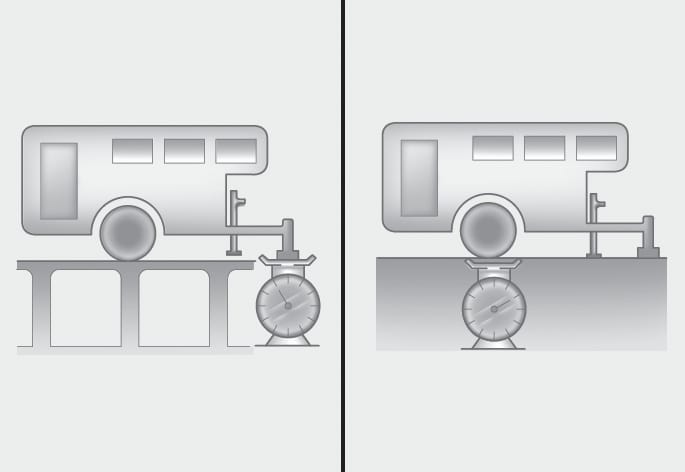
OOSH069129L
Check if the total load is within limits at a public scale. If a public scale is not available, add the estimated weight of your cargo load to the weight of your trailer (as specified by your trailer manufacturer). In addition, measure the tongue load with an appropriate scale or tongue gauge, or estimate it based on the cargo distribution.
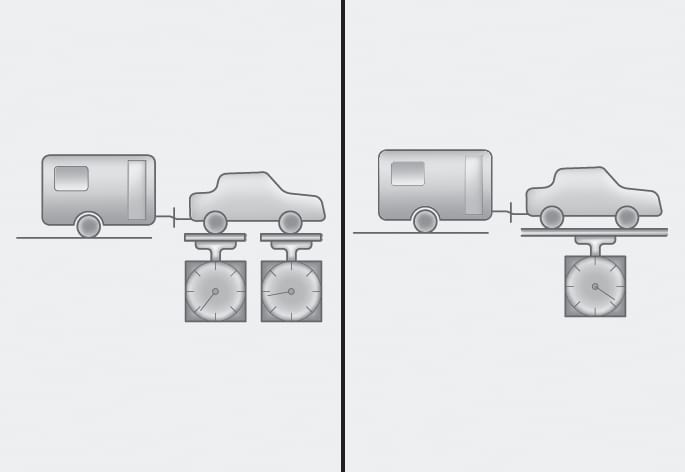
OOSH069130L
The tongue load is extremely important when setting up your trailer for towing with your vehicle. Excessive tongue load reduces front tire traction and steering control. For example, too little tongue load can make the trailer unstable, causing the trailer to sway because the weight of the trailer is shifted to the rear.
The tongue load measured at the hitch when fully loaded should be within 10-15% of the total weight of the trailer.
Be sure to check the load of your vehicle and trailer before driving. Check if the total load is within limits at a public scale. In addition, measure the tongue load with an appropriate scale or tongue gauge.
If a public scale is not available, estimate the weight of your cargo load and add the value to the weight of your trailer (as specified by the trailer manufacturer). Refer to the trailer's manual for additional information.
Never exceed the gross vehicle weight rating (GVWR) for your vehicle.
How to Weigh the Trailer Loads at a Public Scale
Fully load the vehicle and trailer before going to the public scale. You and passengers should remain in the vehicle when performing the measurement.
-
Measure the front gross axle weight.
-
Measure the gross vehicle weight.
-
Measure the rear gross axle weight.
-
Measure the gross combined weight (vehicle and trailer).
-
Measure the hitched trailer weight.
-
Measure the unhitched trailer weight.
To calculate the tongue load, subtract (5) from (6).
After you have loaded your trailer, weigh the trailer and then the tongue separately, to see if the weights are proper. If not, you can correct them simply by moving some items around in the trailer.
To prevent serious injury or death:
-
Never load a trailer with more weight in the rear than in the front. The front must be loaded with approximately 60% of the total trailer load. The rear must be loaded with approximately 40% of the total trailer load.
-
Never exceed the maximum weight limits of the trailer or trailer towing equipment. Check weights and loading at a commercial scale or highway patrol office equipped with scales.
The following table indicates the maximum trailer weight for your vehicle. Do not exceed the maximum allowable trailer weight. The maximum trailer weight includes the weight of the trailer, any cargo, and equipment or items attached to the trailer. The towing load in excess of these limits can seriously affect vehicle steering and performance, and may damage the engine and drivetrain.
|
Item |
Smartstream G2.5 GDI |
|
|
Maximum trailer weight |
Without braking system |
1,653 lbs. (750 kg) |
|
With braking system |
2,000 lbs. (907 kg) |
|
|
Maximum permissible tongue weight |
220 lbs. (100 kg) |
|
|
Recommended distance from rear wheel center to coupling point |
40.3 inches (102.5 cm) |
|
Any additional weight, cargo, or accessories in your vehicle will reduce the maximum trailer weight and corresponding tongue load limits.