Automatic transmission operation
The automatic transmission has eight forward speeds and one reverse speed.
The individual speeds are selected automatically in the D (Drive) position.
The indicator in the instrument cluster displays the shift lever/button position when the ignition switch is in the ON position.
To reduce the risk of serious injury or death:
-
ALWAYS check the surrounding areas near your vehicle for people, especially children, before shifting a vehicle into D (Drive) or R (Reverse).
-
Before leaving the driver's seat, always make sure the vehicle is shifted to the P (Park) position, then set the parking brake, and place the ignition switch in the LOCK/OFF position. Unexpected and sudden vehicle movement can occur if these precautions are not followed.
-
When using the paddle shifter (manual shift mode), do not use engine braking (shifting from a high gear to lower gear) rapidly on slippery roads. The vehicle may slip causing an accident.
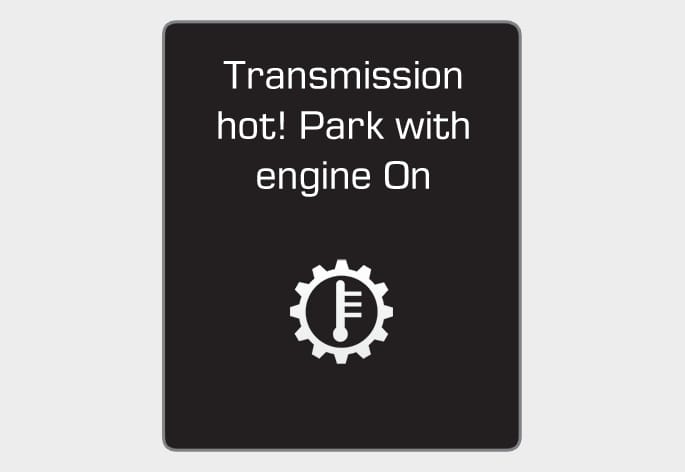
OOSH069007L
-
This message is displayed when the transmission oil temperature is high.
-
Under certain conditions, such as repeated stop-and-go launches on steep grades, sudden take off or acceleration, or other harsh driving conditions, the transmission clutch temperatures will increase excessively.
-
If this occurs, pull over to a safe location, stop the vehicle with the engine running, apply the brakes and shift the vehicle to P (Park), and allow the transmission to cool.
OIK060065L
-
This message is displayed when the transmission oil temperature is high.
-
Drive at steady speed or stop the vehicle at a safe place with the engine on. When the oil temperature returns to normal, the message will disappear.
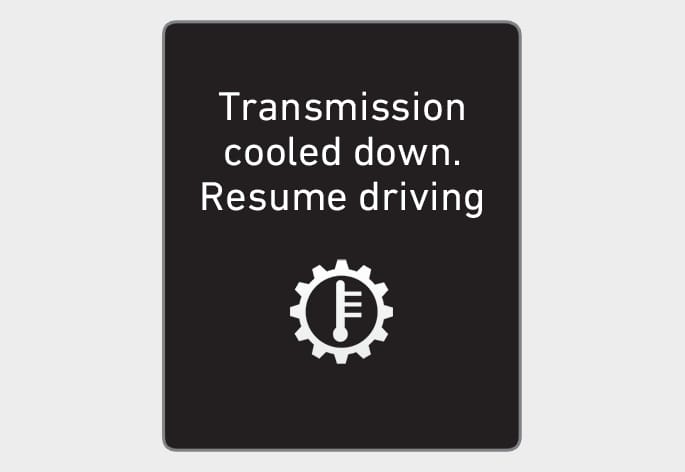
OOSH069014L
-
When the message "Trans cooled. Resume driving" appears you can continue to drive your vehicle.
The indicator in the instrument cluster displays the shift lever/button position when the ignition switch is in the ON position.
P (Park)
Always come to a complete stop before shifting into P (Park).
To shift from P (Park), you must depress firmly on the brake pedal and make sure your foot is off the accelerator pedal.
If you have done all of the above and still cannot shift the lever out of P (Park), see "Shift-Lock Release" in this chapter. (shift lever type)
The shift lever/button must be in P (Park) before turning the engine off.
-
Shifting into P (Park) while the vehicle is in motion may cause you to lose control of the vehicle.
-
After the vehicle has stopped, always make sure the vehicle is in P (Park), apply the parking brake, and turn the engine off.
-
When parking on an incline, shift the gear to P (Park) and apply the parking brake to prevent the vehicle from rolling downhill.
-
Do not use the P (Park) position in place of the parking brake.
R (Reverse)
Use this position to drive the vehicle backward.
Always come to a complete stop before shifting into or out of R (Reverse); you may damage the transmission if you shift into R (Reverse) while the vehicle is in motion.
When the vehicle is stopped in R (Reverse) position, if you open the driver's door with the seat belt unfastened, the gear is shifted to P (Park) position automatically (button type).
However when the vehicle moves in R (Reverse) position, if you open the driver's door with the seat belt unfastened, the gear may be not shifted to P (Park) position automatically for protecting the automatic transmission (button type).
N (Neutral)
The wheels and transmission are not engaged.
Use N (Neutral) if you need to restart a stalled engine, or if it is necessary to stop with the engine ON. Shift into P (Park) if you need to leave your vehicle for any reason.
Always depress the brake pedal when you are shifting from N (Neutral) to another gear.
Do not shift into gear unless your foot is firmly on the brake pedal. Shifting into gear when the engine is running at high speed can cause the vehicle to move very rapidly. You could lose control of the vehicle and hit people or objects.
D (Drive)
This is the normal driving position. The transmission will automatically shift through a 6(or 8)-gear sequence, providing the best fuel economy and power.
To start the vehicle forward, push the D (Drive) button by depressing the brake pedal with the engine ON. (button type)
Then depress the accelerator pedal smoothly.
For extra power when passing another vehicle or driving uphill, depress the accelerator more. Then, the transmission will automatically downshift to the next lower gear (or gears, as appropriate).
When the vehicle is stopped in D (Drive) position, if you open the driver's door with the seat belt unfastened, the gear is shifted to P (Park) position automatically. (button type)
However when the vehicle moves in D (Drive) position, if you open the driver's door with the seat belt unfastened, the gear may be not shifted to P (Park) position automatically for protecting the automatic transmission. (button type)
The DRIVE MODE switch, allows the driver to switch from NORMAL mode to SPORT or ECO mode.
For more Details, refer to "Drive mode integrated control system (2WD)" later in this chapter.
To stay in N (Neutral) when the engine is OFF (button type)
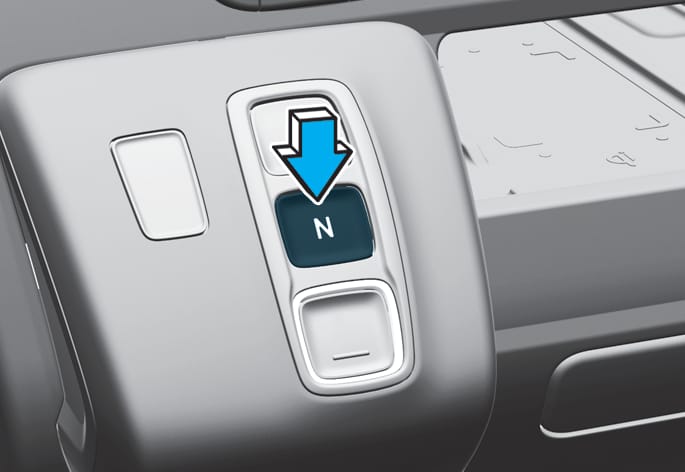
OUS4061003
ODN8069007
ODN8069008
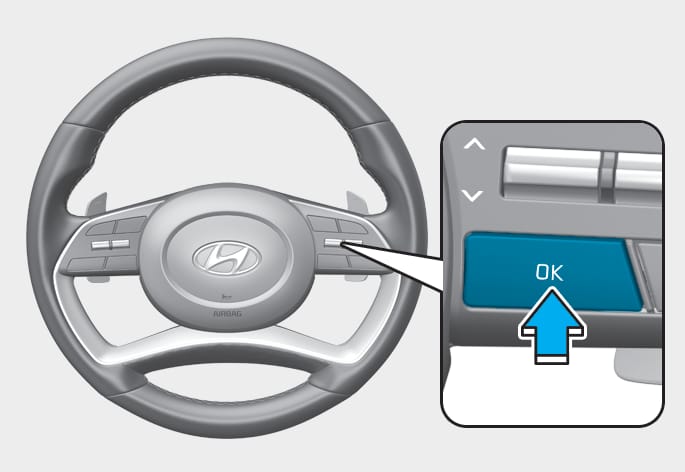
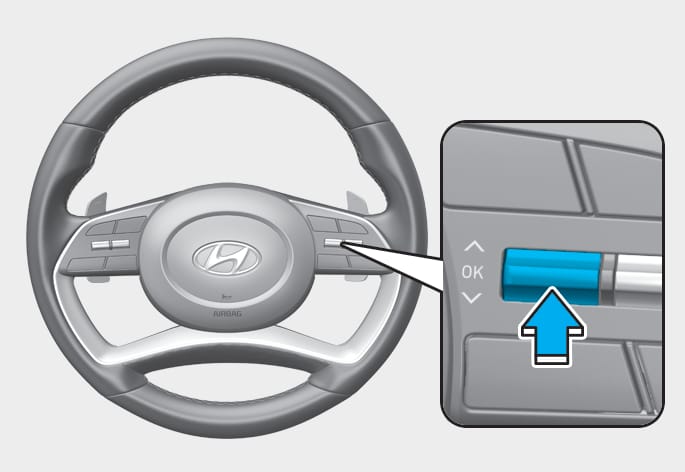
If you want to stay in N (Neutral) after the engine is OFF (in the ACC state), do the following.
-
Release the parking brake when the engine is running or the Engine Start/Stop button is ON position. If the activate AUTO HOLD, please turn off AUTO HOLD.
-
Push the N (neutral) button while depressing the brake pedal.
-
When you take your foot off the brake pedal, the message 'Press and hold OK button to stay in Neutral when vehicle is Off' (or 'Hold OK button to stay in neutral gear position when vehicle is Off') will appear on the Cluster display.
-
Press and hold the OK button on the steering wheel for more than 1 second
-
When the message 'Vehicle will stay in (N). Change gear to cancel' (or 'N will stay engaged when the vehicle is Off') will appear on the Cluster display, press the Engine Start/Stop button while depressing the brake pedal.
However, if you unfasten the driver's seat belt and open the driver's door, the gear will automatically shift to P (Park) and the ignition switch will change to the LOCK/OFF position.
With the gear in N (Neutral) the ignition switch will be in the ACC position. In the ACC position, the doors cannot be locked. The battery may discharge if left in the ACC position for a long time.
OUS4061037
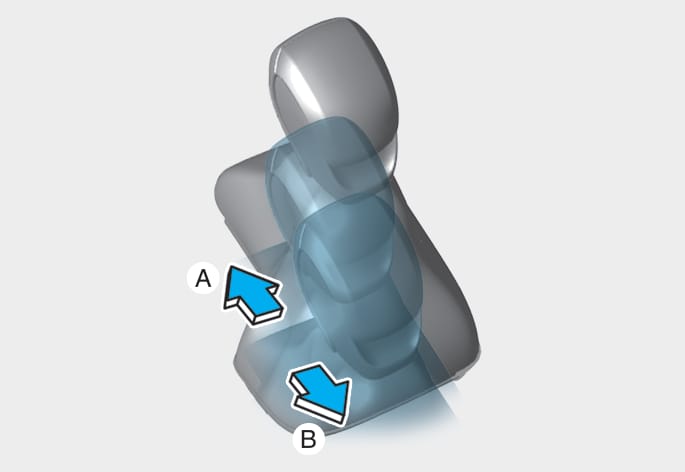
- : + (Up)
- : - (Down)
Whether the vehicle is stationary or in motion, manual shift mode is selected by pushing the shift lever from the D (Drive) position into the manual gate. To return to D (Drive) range operation, push the shift lever back into the main gate.
In manual shift mode, moving the shift lever backwards and forwards will allow you to select the desired range of gears for the current driving conditions.
+ (Up) : Push the lever forward once to shift up one gear.
- (Down) : Pull the lever backwards once to shift down one gear.
-
Only the eight forward gears can be selected. To reverse or park the vehicle, move the shift lever to the R (Reverse) or P (Park) position as required.
-
Downshifts are made automatically when the vehicle slows down. When the vehicle stops, 1st gear is automatically selected.
-
When the engine rpm approaches the red zone the transmission will upshift automatically.
-
If the driver presses the lever to + (Up) or - (Down) position, the transmission may not make the requested gear change if the next gear is outside of the allowable engine rpm range. The driver must execute upshifts in accordance with road conditions, taking care to keep the engine rpms below the red zone.
-
When driving on a slippery road, push the shift lever forward into the + (Up) position. This causes the transmission to shift into the 2nd gear which is better for smooth driving on a slippery road. Push the shift lever to the - (Down) side to shift back to the 1st gear.
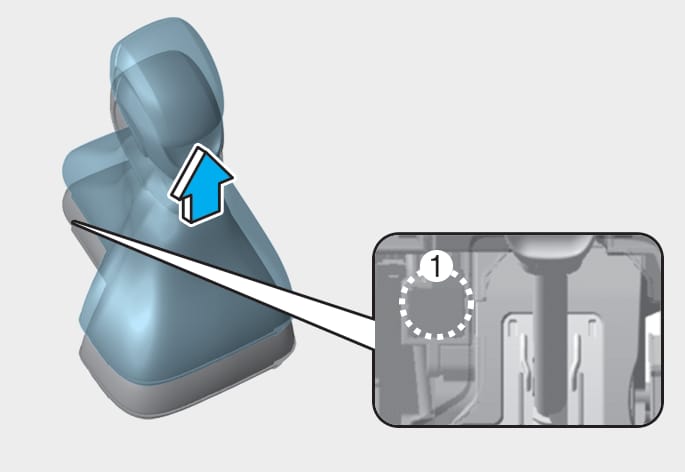
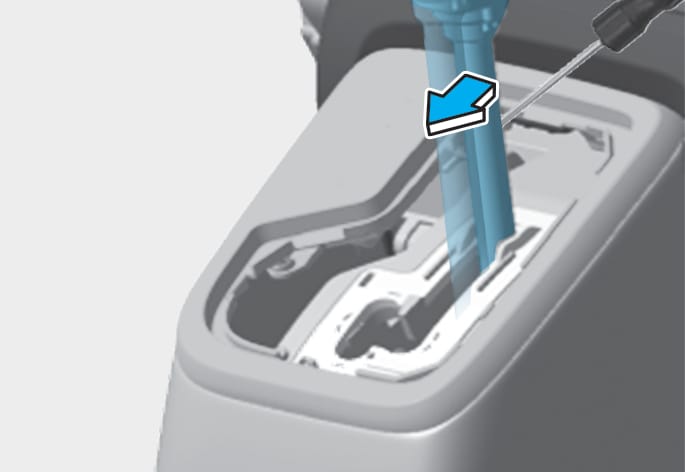
If the shift lever cannot be moved from the P (Park) position into R (Reverse) position with the brake pedal depressed, continue depressing the brake, and then do the following:
OUS4061040
OUS4061041
-
Place the ignition switch in the LOCK/OFF position.
-
Apply the parking brake.
-
Carefully remove the shift lever boots.
-
Move the Shift lever while holding the release button (1) with a tool (for example, flat head screw-driver).
If you need to use the shift-lock release, we recommend that the system be inspected by an authorized HYUNDAI dealer immediately.
For your safety, the automatic transmission has a shift-lock system which prevents shifting the transmission from P (Park) into R (Reverse) unless the brake pedal is depressed.
To shift the transmission from P (Park) into R (Reverse):
-
Depress and hold the brake pedal.
-
Start the engine or place the ignition switch in the ON position.
-
Depress the brake pedal and move the shift lever to R (Reverse). (lever type)
Depress the brake pedal and push the R (Reverse) button. (button type)
The ignition key cannot be removed unless the shift lever is in the P (Park) position.
You cannot shift gears, when the battery is discharged.
In emergencies, do the following to shift the gear to N (Neutral) on a level ground.
-
Connect the battery cables from another vehicle or from a another battery to the jump-starting terminals inside the engine compartment.
For more details, refer to "Jump starting" in chapter 8.
-
Release the parking brake with the ignition switch in the ON position.
-
Shift the gear to the N(Neutral) position refer to the "#ida8543d9b65c/id231GA0K80PF" in this chapter.