Snow or Icy Conditions
You need to keep sufficient distance between your vehicle and the vehicle in front of you.
Apply the brakes gently. Speeding, rapid acceleration, sudden brake applications, and sharp turns are very hazardous practices. Sudden brake applications on snowy or icy roads may cause the vehicle to skid.
To drive your vehicle in deep snow, it may be necessary to use snow tires or to install tire chains on your tires.
Always carry emergency equipment. You may want to carry tire chains, tow straps or chains, a flashlight, emergency flares, sand, a shovel, jumper cables, a window scraper, gloves, ground cloth, coveralls, a blanket, etc.
Snow tires should be equivalent in size and type to the vehicle's standard tires. Otherwise, the safety and handling of your vehicle may be adversely affected.
Use snow tires when the road temperature is below 45 °F (7 °C). If you mount snow tires on your vehicle, be sure to use the same inflation pressure as the original tires. Mount snow tires on all four wheels to balance your vehicle's handling in all weather conditions.
The traction provided by snow tires on dry roads may not be as high as your vehicle's original equipment tires. Check with the tire dealer for maximum speed recommendations.
2C_TireChain
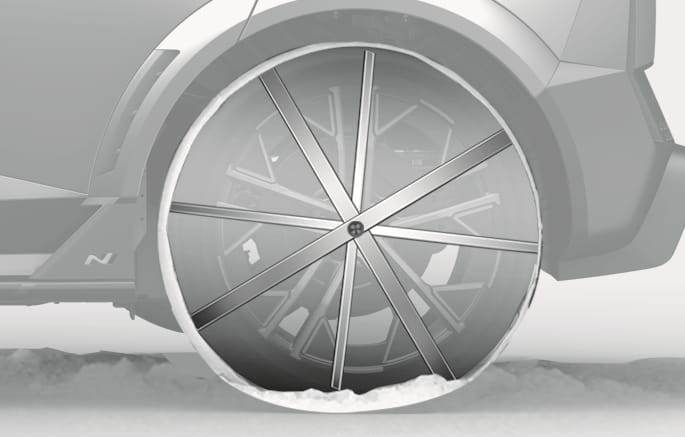
Since the sidewalls on some radial tires are thinner than other types of tires, they may be damaged by mounting certain types of tire chains on them. Therefore, the use of snow tires is recommended instead of tire chains. Do not mount tire chains on vehicles equipped with aluminum wheels; if possible, use AutoSock (fabric snow chain). Install the tire chains after reviewing the instructions provided with the tire chains. Damage to your vehicle caused by improper tire chain use is not covered by your vehicle manufacturer's warranty.
The use of AutoSock (fabric snow chain) may adversely affect vehicle handling:
-
Drive less than 20 mph (30 km/h) or the chain manufacturer's recommended speed limit, whichever is lower.
-
Drive carefully and avoid bumps, holes, sharp turns, and other road hazards, which may cause the vehicle to bounce.
-
Avoid sharp turns or locked wheel braking.
-
Install AutoSock (fabric snow chain) only in pairs and on the rear tires. Installing AutoSock (fabric snow chain) on the tires provides a greater driving force, but does not prevent side skids.
Do not install studded tires without first checking local and municipal regulations for possible restrictions against their use.
Chain installation
When installing AutoSock (fabric snow chain), follow the manufacturer's instructions and mount them as tightly as possible. Drive slowly (less than 20 mph (30 km/h) or the chain manufacturer's recommended speed limit) with chains installed. If you hear the chains contacting the body or chassis, stop and tighten them. If they still make contact, slow down until the noise stops. Remove the AutoSock (fabric snow chain) as soon as you begin driving on cleared roads.
When mounting AutoSock (fabric snow chain), park the vehicle on level ground away from traffic. Turn on the vehicle's Hazard Warning Flasher and place a triangular emergency warning device behind the vehicle (if available).
Always place the vehicle in P (Park), apply the parking brake, and turn off the vehicle before installing tire chains.
When using AutoSock (fabric snow chains):
-
Wrong size chains or improperly installed chains may damage your vehicle's brake lines, suspension, body, and wheels.
-
If you hear noise caused by chains contacting the body, retighten the chains to prevent contact with the vehicle body.
-
To prevent body damage, retighten the chains after driving 0.3-0.6 mi. (0.5-1.0 km).