Installing a Child Restraint System
Before installing your Child Restraint System, always read and follow the instructions provided by the manufacturer of the Child Restraint System and in this manual to prevent serious injury or death if a collision occurs.
If the vehicle headrest prevents proper installation of a Child Restraint System (as described in the Child Restraint System manual), readjust or remove the headrest for that seating position.
After selecting a proper Child Restraint System for your child and checking that the Child Restraint System fits properly in a seating position, there are three general steps for a proper installation:
-
Properly secure the Child Restraint System to the vehicle. All Child Restraint Systems must be secured to the vehicle with a lap/shoulder belt or with an ISOFIX top tether and/or ISOFIX anchorage and/or with a support leg.
-
Make sure the Child Restraint System is firmly secured. After installing a Child Restraint System to the vehicle, push and pull the seat forwards and backwards and from side to side to verify that it is securely attached to the seat. A child restraint secured with a seat belt should be installed as firmly as possible. However, Some side-to-side movement can be expected.
-
Secure the child in the Child Restraint System. Make sure the child is properly strapped in the Child Restraint System according to the Child Restraint System manufacturer's instructions.
Check the seating surface and buckles before placing your child in the Child Restraint System to prevent burns. A Child Restraint System in a closed vehicle can become very hot.
(Information for vehicle users and CRS manufacturers)
-
Yes: Suitable for fitment of the designated category of CRS.
-
No: Not suitable for fitment of the designated category of CRS.
-
-: Not applicable.
-
The table is based on left-hand drive vehicle. Except for the front passenger seat, the table is valid for right-hand drive vehicle. For right-hand drive vehicle front passenger seat, use information for the seating position number 3.
|
CRS categories |
Seating positions |
|||||
|
1,2 |
3 |
4 |
5 |
|||
|
Airbag ON |
Airbag OFF |
|||||
|
Universal belted CRS |
All mass groups |
- |
No |
Yes*1 F, R |
Yes F, R |
Yes F, R |
|
i-size CRS |
ISOFIX CRF: F2, F2X, R1, R2 |
- |
No |
No |
Yes F, R |
Yes F, R |
|
Carry-cot (ISOFIX lateral facing CRS) |
ISOFIX CRF: L1, L2 |
- |
No |
No |
No |
No |
|
ISOFIX infant* CRS (*: ISOFIX baby CRS) |
ISOFIX CR: R1 |
- |
No |
No |
Yes R |
Yes R |
|
ISOFIX toddler CRS - small |
ISOFIX CRF: F2, F2X, R2, R2X |
- |
No |
No |
Yes F, R |
Yes F, R |
|
ISOFIX toddler CRS - large*(*: not booster seats) |
ISOFIX CRF: F3, R3 |
- |
No |
No |
Yes F, R |
Yes F, R |
|
Booster Seat - reduced width |
ISO CRF: B2 |
- |
No |
No |
Yes |
Yes |
|
Booster Seat - full width |
ISO CRF: B3 |
- |
No |
No |
Yes |
Yes |
To install Universal CRS, 1st row passenger seat should be adjusted to the appropriate position which do not interfere with stable installation (adjust to possible height or upright position)
F: Forward facing, R: Rearward facing
-
If the vehicle headrest prevents proper installation of a CRS, the headrest of the seating position shall be readjusted or entirely removed.
-
Never place a rearward facing Child Restraint System on the front passenger seat, unless the airbag is deactivated.
-
For semi-universal or vehicle specific CRS (ISOFIX or belted CRS), please see the vehicle list provided in the manual of CRS.
-
When Installing Child Restraint system on 2nd row seats, move the seat to mid-position.
-
If the headrests prevent proper installation of a CRS, the headrests of the seating position shall be readjusted or entirely removed
-
Never place a rearward facing Child Restraint System on the front passenger seat, unless the airbag is deactivated.
|
Seat number |
Position in the vehicle |
Seating positions |
|
1 |
Front left |

|
|
2 |
Front center |
|
|
3 |
Front right |
|
|
4 |
2nd row left |
|
|
5 |
2nd row right |
|
Child Height |
Name |
Manufacturer |
Type of Fixation |
|
40 – 83 cm |
BABY-SAFE 3 i-Size with FLEX BASE i-Sense |
Britax |
ISOFIX with supported leg (RWF) |
|
76 – 105 cm |
Trifix2 i-Size |
Britax |
ISOFIX mounted with top-tether |
|
100 – 150 cm |
Solution T i-Fix |
Cybex |
ISOFIX |
|
135 – 150 cm |
Booster Basic R129 |
Graco |
Vehicle Belt |
CRS Manufacturer information
Britax: https://www.britax-roemer.com/
Cybex: https://www.cybex-online.com/
Graco: https://www.graco.com
The ISOFIX system connects a Child Restraint System to the vehicle during driving and in a collision. This system is designed to make installation of the Child Restraint System easier and reduce the possibility of improperly installing your Child Restraint System. The ISOFIX system uses anchors in the vehicle and attachments on the Child Restraint System. The ISOFIX system eliminates the need to use seat belts to secure the Child Restraint System to the rear seats.
ISOFIX anchorages are metal bars built into the vehicle. There are two lower anchors for each ISOFIX seating position that accommodates a Child Restraint System with lower attachments.
To use the ISOFIX system in your vehicle, install a Child Restraint System with ISOFIX attachments. (An ISOFIX Child Restraint System may only be installed if it has vehicle specific or universal approval in accordance with the requirements of ECE-R44 or ECE-R129.)
The Child Restraint System manufacturer provides you with instructions on how to use the Child Restraint System with its attachments for the ISOFIX anchorages.

2C_ALRSeatBeltLowerAnchorOverview
ISOFIX anchorages have been provided in the left and right outboard rear seating positions. Their locations are shown in the illustration.

2C_ALRSeatBeltLowerAnchor
- ISOFIX anchorage position indicator (
Ŏ ) - ISOFIX anchorage
The ISOFIX anchorage position indicator symbols are located on the left and right rear seatbacks to identify the positions of the lower anchors in your vehicle.
Both rear outboard seats are equipped with a pair of ISOFIX anchorages as well as a corresponding top tether anchorage on the back side of the rear seats.
(Child Restraint Systems with universal approval according to ECE-R44 or ECE-R129 need to be fixed additionally with a top tether connected to the back side of the rear seats.)
The ISOFIX anchorages are located between the seatback and the seat cushion of the rear seat left and right outboard seating positions.
Before installing the Child Restraint System, make sure that there are no objects (for example, toys, pens, wires) near the ISOFIX anchorage area. Those objects may damage either the seat belt system or the Child Restraint System during installation. If necessary, we recommend that the vehicle be inspected by an authorized HYUNDAI dealer.
To install an i-Size or ISOFIX-compatible Child Restraint System in either of the rear outboard seating positions:
-
Move the seat belt buckle away from the ISOFIX anchorages.
-
Move any other objects away from the anchorages that could prevent a secure connection between the Child Restraint System and the ISOFIX anchorages.
-
Place the Child Restraint System on the vehicle seat, then attach the seat to the ISOFIX anchorages according to the instructions provided by the Child Restraint System manufacturer.
-
Follow the instructions of the Child Restraint System's manufacturer for proper installation and connection of the ISOFIX attachments on the Child Restraint System to the ISOFIX anchorages.
Take the following precautions when using the ISOFIX system:
-
Read and follow all installation instructions provided with your Child Restraint System.
-
To prevent the child from reaching and taking hold of unretracted seat belts, buckle all unused rear seat belts and retract the seat belt webbing behind the child. The child can be strangled if a shoulder belt becomes wrapped around their neck and the seat belt tightens.
-
Never attach more than one Child Restraint System to a single anchorage. This may cause the anchorage or attachment to come loose or break.
-
Always have the ISOFIX system inspected by your dealer after a collision. A collision can damage the ISOFIX system and may not properly secure the Child Restraint System.
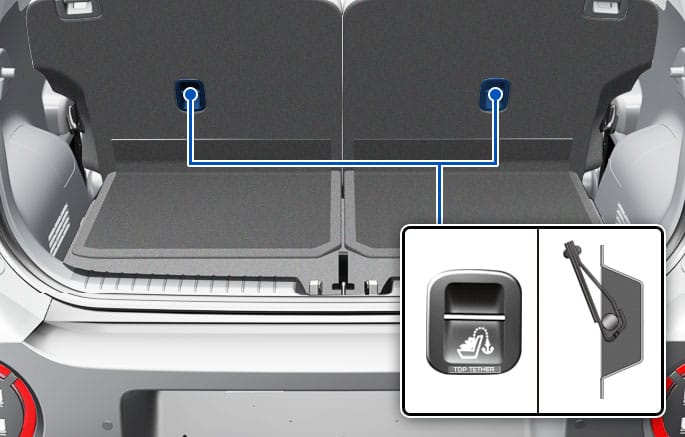
2C_ALRSeatBeltTetherAnchor
First secure the child restraint with the ISOFIX anchorages or the seat belt. If the child restraint manufacturer recommends that the top tether strap be attached, attach and tighten the top tether strap to the top tether strap anchorage.
Top tether anchorages are located on the rear of the seatbacks.
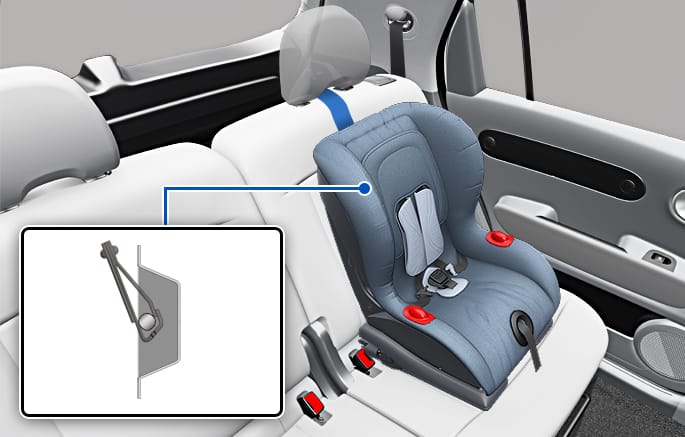
2C_ALRSeatBeltTetherAnchorInstall
To install the top tether anchor:
-
Route the Child Restraint System top tether strap over the seatback. Route the tether strap under the headrest and between the headrest posts, or route the top tether strap over the top of the vehicle seatback. Make sure the strap is not twisted.
-
Connect the top tether strap hook to the top tether anchorage, then tighten the top tether strap according to the instructions of your Child Restraint System's manufacturer to firmly secure the Child Restraint System.
-
Check the Child Restraint System is secure by pushing and pulling the seat forward and back and side-to-side.
Take the following precautions when installing the top tether anchorage:
-
Read and follow all installation instructions provided with your Child Restraint System.
-
Never attach more than one Child Restraint System to a single ISOFIX top tether anchorage. This could cause the anchorage or attachment to come loose or break.
-
Only attach the top tether strap to the correct top tether anchorage for that seating position.
-
Child Restraint System anchorages are designed to withstand only those loads imposed by correctly fitted Child Restraint System.
Under no circumstances are they to be used for adult seat belts or harnesses or for attaching other items or equipment to the vehicle.
When not using the ISOFIX system, all Child Restraint Systems must be secured to a rear seat using the lap/shoulder belt.
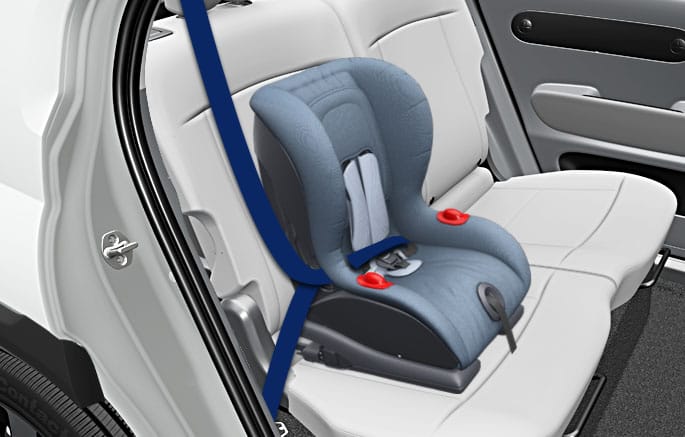
2C_ALRSeatBeltInstall
Installing a Child Restraint System with a lap/shoulder belt
To install a Child Restraint System on the rear seats:
-
Place the Child Restraint System on a rear seat and route the lap/shoulder belt around or through the Child Restraint System, following the Child Restraint System manufacturer's instructions. Make sure the seat belt webbing is not twisted.
-
Fasten the lap/shoulder belt latch into the buckle. Listen for the distinct "click" sound.
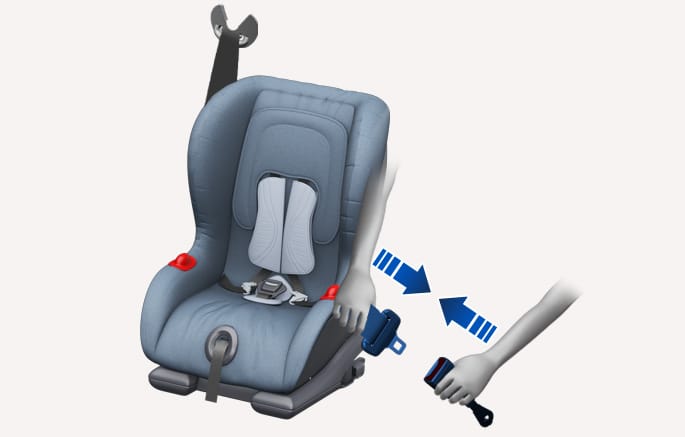
2C_ALRSeatBeltInstall_2
Position the release button so that it is easy to access in an emergency.
-
Remove as much slack from the belt as possible by pushing down on the Child Restraint System while feeding the shoulder belt back into the retractor.
-
Push and pull on the Child Restraint System to confirm that the seat belt is holding it firmly in place.
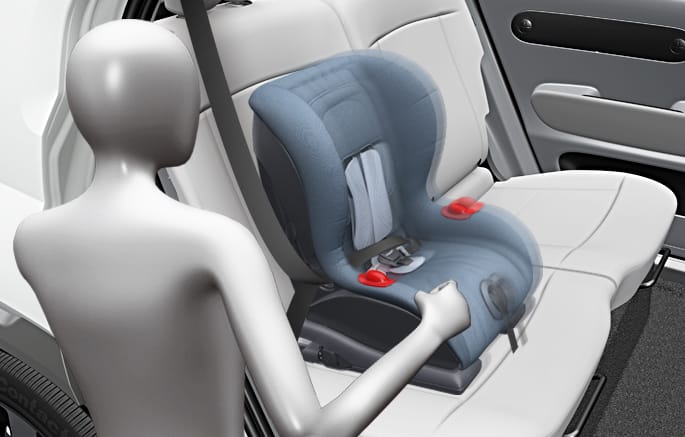
2C_ALRSeatBeltInstall_5
If your Child Restraint System manufacturer instructs or recommends you to use a top tether anchorage with the lap/shoulder belt, refer to "Securing a Child Restraint System seat with Top Tether Anchorage system" section for more information.
To remove the Child Restraint System, press the release button on the buckle and then pull the seat belt out of the Child Restraint System and allow the seat belt to retract fully.