Winter Driving
Use high quality ethylene glycol coolant
Your vehicle is delivered with high quality ethylene glycol coolant in the cooling system. It is the only type of coolant that should be used because it helps prevent corrosion in the cooling system, lubricates the water pump, and prevents freezing. Be sure to replace or replenish your coolant in accordance with the Scheduled Maintenance Services. Before winter, have your coolant tested to make sure that its freezing point is sufficient for the temperatures anticipated during the winter.
Check battery and cables
Winter temperatures may affect the battery performance. Inspect the battery and cables, as specified in chapter 9. The battery charging level can be checked by an authorized HYUNDAI dealer or in a service station.
Change to 'winter weight' oil if necessary
In some regions in winter, it is recommended to use the 'winter weight' oil with lower viscosity. In addition, replace the engine oil and filter if it is close to the next maintenance interval. Fresh engine oil ensures optimum engine operation during the winter months. For more information, refer to Recommended Lubricants and Capacities. When you are not sure about a type of winter weight oil, contact an authorized HYUNDAI dealer.
Check spark plugs and ignition system
Inspect the spark plugs, as specified in chapter 9. If necessary, replace them. Also check all ignition wirings and components for any cracks, wear, and damage.
To prevent locks from freezing
Spray approved de-icing fluid or glycerin into key holes. When a lock opening is already covered with ice, spray approved de-icing fluid over the ice to remove it. When an internal part of a lock freezes, try to thaw it with a heated key. Carefully use the heated key to avoid an injury.
Use approved window washer anti-freeze solution
Add window washer anti-freeze solution, as specified on the window washer container. Window washer anti-freeze solution is available from an authorized HYUNDAI dealer, and most vehicle accessory outlets.
Do not use engine coolant or other types of anti-freeze solution, to prevent any damage to the vehicle paint.
Do not let your parking brake freeze
Under some conditions, your parking brake may freeze in the engaged position. This is most likely to happen when there is an accumulation of snow or ice around or near the rear brakes or the brakes are wet. When there is the risk that your parking brake may freeze: temporarily apply the parking brake with the gear in P (Park), then block the rear wheels, and then release the parking brake.
Do not let ice and snow accumulate underneath
Under some conditions, snow and ice may build up under the fenders and interfere with the steering. When driving in such conditions during the severe winter, check underneath the vehicle on a regular basis, to make sure that the front wheels and the steering components are not blocked.
Carry emergency equipment
In accordance with weather conditions, carry appropriate emergency equipment, while driving. Some of the items you may want to carry include tire chains, tow straps or chains, flashlight, emergency flares, sand, shovel, jumper cables, window scraper, gloves, ground cloth, coveralls, blanket, etc.
Do not place objects or materials in the engine compartment
Putting objects or materials in the engine compartment may cause an engine failure or a fire, because they may block the engine cooling. Such damage is not covered by the manufacturer's warranty.
Drive your vehicle when water vapor condenses and accumulates inside the exhaust pipes
When the vehicle is stopped for a long time in winter while the engine is running, water vapor may condense and accumulate inside the exhaust pipes. Water in the exhaust pipes may cause noise, etc., but it is drained when driving at medium to high speed.
You need to keep sufficient distance between your vehicle and the vehicle in front.
Apply the brakes gently. Speeding, rapid acceleration, sudden brake applications, and sharp turns are very hazardous practices. When decelerating, use engine braking to the fullest extent. Sudden brake applications on snowy or icy roads may cause the vehicle to skid.
To drive your vehicle in deep snow, it may be necessary to use snow tires or to install tire chains on your tires.
Always carry emergency equipment. You may want to carry tire chains, tow straps or chains, a flashlight, emergency flares, sand, a shovel, jumper cables, a window scraper, gloves, ground cloth, coveralls, a blanket, etc.
Use snow tires when the road temperature is below 45 °F (7 °C). If you mount snow tires on your vehicle, be sure to use the same inflation pressure as the original tires. Mount snow tires on all four wheels to balance your vehicle's handling in all weather conditions.
The traction provided by snow tires on dry roads may not be as high as your vehicle's original equipment tires. Check with the tire dealer for maximum speed recommendations.
Snow tires should be equivalent in size and type to the vehicle's standard tires. Otherwise, the safety and handling of your vehicle may be adversely affected.
The use of tire chains may adversely affect vehicle handling:
-
Drive less than 20 mph (30 km/h) or the chain manufacturer's recommended speed limit, whichever is lower.
-
Drive carefully and avoid bumps, holes, sharp turns, and other road hazards, which may cause the vehicle to bounce.
-
Avoid sharp turns or locked wheel braking.
-
Install tire chains only in pairs and on the front tires. Installing tire chains on the tires provides a greater driving force, but does not prevent side skids.
Fabric type chain (If equipped)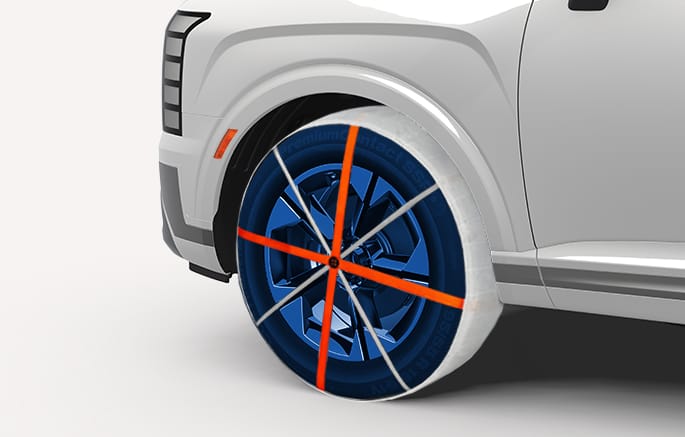
2C_TireChain_2
Since the sidewalls of radial tires are thinner than other types of tires, they may be damaged by mounting some types of tire chains on them. Therefore, the use of snow tires is recommended instead of tire chains. If tire chains must be used, use genuine HYUNDAI Parts and install the tire chains after reviewing the instructions provided with the tire chains. Damage to your vehicle caused by improper tire chain use is not covered by your vehicle manufacturer's warranty.
|
235/65 R18 255/50 R20 265/45 R21 |
Fabric-type chain |
When using tire chains, attach them to the front wheels.
Do not install studded tires without first checking local and municipal regulations for possible restrictions against their use.
Chain Installation
When installing tire chains, follow the manufacturer's instructions and mount them as tightly possible. Drive slowly (less than 20 mph (30 km/h) or the chain manufacturer's recommended speed limit) with chains installed. If you hear the chains contacting the body or chassis, stop and tighten them. If they still make contact, slow down until the noise stops. Remove the tire chains as soon as you begin driving on cleared roads.
When mounting snow chains, park the vehicle on level ground away from traffic. Turn on the vehicle's Hazard Warning Flasher and place a triangular emergency warning device behind the vehicle (if available). Always place the vehicle in P (Park), apply the parking brake, and turn off the engine before installing snow chains.
When using tire chains:
-
Wrong size chains or improperly installed chains may damage your vehicle's brake lines, suspension, body, and wheels.
-
Use SAE 'S' class or wire chains.
-
If you hear noise caused by chains contacting the body, retighten the chains to prevent contact with the vehicle body.
-
To prevent body damage, retighten the chains after driving 0.3-0.6 mi. (0.5-1.0 km).
-
Do not use tire chains on vehicles equipped with aluminum wheels. If unavoidable, use a wire type chain.
-
Use wire chains less than 0.47 in. (12 mm) thick to prevent damage to the chain's connection.