Distance To Empty
2C_DistanceToEmpty
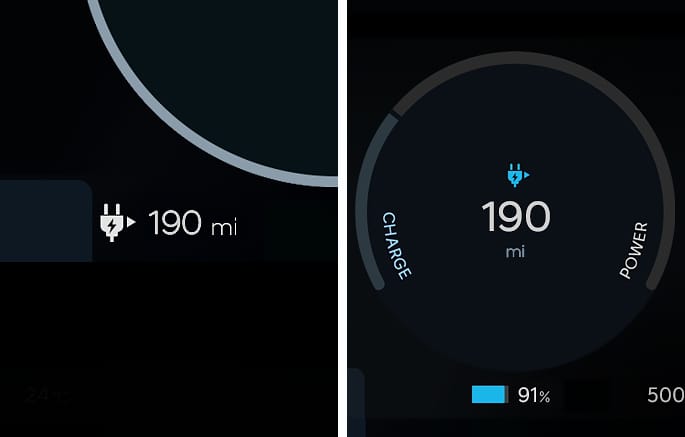
The distance to empty refers to the distance that can be driven by the current charged battery level and is displayed on the bottom of the cluster display while driving the electric vehicle.
The distance to empty vary depending on many factors such as driving habits, power usage, driving conditions, and high voltage battery. The distance to empty may differ from the certified figures as it reflects the combined result of the factors listed.
-
Driving habits: The driving speed and tendency of accelerating and decelerating. High speed driving or frequent accelerating and decelerating reduces the distance to empty.
-
Power usage: Additional power use, such as the air conditioner, heater, lights, etc. As the power usage increases, the distance to empty reduces.
-
Driving conditions: The weather, temperature, and terrain. If you drive in snow/rain/strong wind or low temperature, the distance to empty will be reduced. The distance to empty will also be reduced when driving uphill or on slippery or rough roads.
-
High voltage barttery energy: Proportional to the SOC, but may vary depending on the battery temperature and the State of Health (SOH) of a battery.
In case the distance to empty has been reduced due to learning of the driving habit or the driving conditions, you can increase the distance to empty again by continuously driving following the 'Tips for enhancing the distance to empty'.
-
Resetting the previously learned driving patterns at the service center may increase the distance to empty displayed on the bottom of the instrument cluster. However, the distance to empty may not be accurate until sufficient distance has been traveled to relearn driving patterns.
-
If the high voltage battery temperature is low in winter, the distance to empty reduces but it is not a permanent change. The distance to empty will increase again once the temperature rises.
-
If you reduce the power usage, the distance to empty will increase.
-
Natural degradation may occur with the high voltage battery depending on the number of years the vehicle is used. This may reduce the distance to empty.
When the destination is set, the distance to empty may change. The distance to empty may vary significantly based on traffic conditions or driving speed.
The distance to empty vary depending on the charge level of the high voltage battery, weather, temperature, duration of the battery use, terrain, driving habits, etc.
-
The air resistance increases rapidly as vehicle speed increases, so avoid speeding to increase the distance to empty and electric energy economy.
-
Rapid acceleration consumes a lot of driving energy and rapid deceleration limits the regenerative braking. Gradually depress and release the accelerator pedal.
-
Excessive heater or air conditioner operation will increase energy consumption from the high voltage battery. This may reduce the distance to empty. Therefore, set the cabin temperature to 72 °F (22 °C) AUTO level 2. Especially in winter, reducing heating and using heated seats instead can significantly increase the distance to empty. Turn off the air conditioner or heater if you do not need them.
-
When using the air conditioner or heater, the energy consumption is reduced if recirculation mode is selected instead of fresh mode.
-
Close the windows while driving.
-
When using the air conditioner or heater while driving alone, use the DRIVER ONLY function.
-
Always maintain specified tire pressures and use tires for electric vehicles.
-
Do not use unnecessary electrical components while driving.
-
Do not load unnecessary items in the vehicle.
-
Do not mount parts that may increase air resistance.
-
When the high voltage battery level warning light is displayed, immediately charge the vehicle at a nearby charging station.
-
When the battery level is 0 %, do not try to drive. Move to a safe place and call for help.