Dual Clutch Transmission operation
The dual clutch transmission has 7 forward speeds and one reverse speed.
The individual speeds are selected automatically in the D (Drive) position.
The indicator on the instrument cluster the shift lever position when the ignition switch is in the ON position.
To reduce the risk of serious injury or death:
-
Always check the surrounding areas near your vehicle for people, especially children, before shifting into D (Drive) or R (Reverse).
-
Before leaving the driver's seat, always make sure the shift lever is in the P (Park) position, then apply the parking brake, and place the ignition switch in the LOCK/OFF position. Unexpected and sudden vehicle movement may occur if these precautions are not followed.
-
Do not use engine braking (using the manual shift mode or paddle shifters to shift from a higher gear to a lower gear) on slippery roads. The vehicle may lose traction with the roadway, resulting in a collision.
-
The dual clutch transmission can be thought of as an automatically shifting manual transmission. It gives the driving feel of a manual transmission, yet provides the ease of a fully automatic transmission.
-
When D (Drive) is selected, the transmission will automatically shift through the gears similar to a conventional automatic transmission. Unlike a traditional automatic transmission, the gear shifting can sometimes be felt and heard as the actuators engage the clutches and the gears are selected.
-
The dual clutch transmission adopts a dry-type dual clutch, which is different from the torque converter of the automatic transmission. It shows better acceleration performance and increased fuel efficiency while driving but initial launch might be little bit slower than the automatic transmission.
As a result, gear shifts are sometimes more noticeable than a conventional automatic transmission and a light vibration during launching can be felt as the transmission speed. This is a normal condition of the dual clutch transmission.
-
The dry-type clutch transfers torque more directly and provides a direct drive feeling which may feel different from a conventional automatic transmission. This may be more noticeable when launching the vehicle from a stop or when traveling at low, stop-and-go vehicle speeds.
-
When rapidly accelerating at a low vehicle speed, the engine rpm may increase highly depending on the vehicle's driving condition.
-
For smooth launch uphill, press down the accelerator pedal smoothly depending on the current conditions.
-
If you release your foot from the accelerator pedal at low vehicle speed, you may feel strong engine braking, which is similar to manual transmission.
-
When driving downhill, you may use Sports Mode or press the paddle shifters (if equipped) to downshift to a lower gear in order to control your speed without using the brake pedal excessively.
-
When you turn the engine on and off, you may hear clicking sounds as the system goes through a self-test. This is a normal sound for the dual clutch transmission.
-
During the first 1000 mi. (1,500 km), you may feel that the vehicle may not be smooth when accelerating at low speed. During this break-in period, the shift quality and performance of your new vehicle is continuously optimized.
In case of transmission failure, you may not continue to drive and the position indicator (D, R) on the cluster will blink. Contact an authorized HYUNDAI dealer and have the system checked.
Always come to a complete stop before shifting into P (Park).
To shift from P (Park), depress the brake pedal firmly and make sure your foot is not depressing the accelerator pedal.
If you cannot shift the lever out of P (Park), refer to the "Shift lock release" section in this chapter if equipped with a shift lever.
-
Shifting into P (Park) while the vehicle is moving may cause you to lose control of the vehicle.
-
After the vehicle has stopped, always make sure the shift lever is in P (Park), apply the parking brake, and turn the engine off.
-
When parking on an incline, shift the gear to P (Park), apply the parking brake, and turn the wheels toward the curb to prevent the vehicle from rolling downhill.
-
Do not use the P (Park) position instead of the parking brake.
Use this position to drive the vehicle backward.
Always come to a complete stop before shifting into or out of (Reverse) to prevent damaging the transmission.
Use N (Neutral) if you need to restart a stalled engine, or if it is necessary to stop with the engine ON. Shift into P (Park) if you need to leave your vehicle for any reason.
The wheels and transmission are not engaged.
Always depress the brake pedal when you are shifting from N (Neutral) to another gear.
The transmission automatically shifts through a 7-gear sequence, providing the best fuel economy and power.
Shift to D (Drive) while depressing the brake pedal with the engine ON. Then release the brake pedal and depress the accelerator pedal.
For extra power when passing another vehicle or driving uphill, depress the accelerator fully. The transmission automatically downshifts to the next lower gear.
The DRIVE MODE switch, located on the shift lever console or on the left side of the dashboard, allows the driver to switch from NORMAL mode to SPORT or SMART mode (if equipped)
For more information, refer to the "Drive mode integrated control system" section in this chapter.
For more information, refer to the "Drive mode integrated control system" section in the complete Owner's Manual.
-
Do not shift into gear unless your foot is firmly on the brake pedal.
-
Do not shift gears with the accelerator pedal depressed. Wait until the engine RPM is normal. The vehicle may suddenly move if you shift gears and release the brake pedal when the RPM is high.
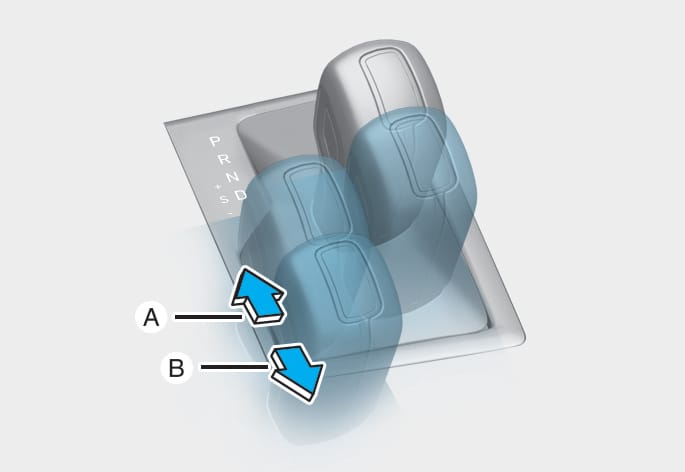
To shift into DS mode, move the shift lever from D (Drive) to the center of the manual shift mode. The engine and transmission control logic is automatically optimized for sporty driving.
In DS mode, if you move the shift lever to + (Up) or - (Down), the gear changes to the manual shift mode. If the shift lever is moved back into D (Drive),it changes to D (Drive) and shifts automatically. The vehicle performs according to the mode selected from the drive mode (NORMAL, SPORT, SMART).
OCN7N063009N
- + (Up)
- - (Down)
Whether the vehicle is stationary or moving, the manual shift mode is selected by pushing the shift lever from the D (Drive) position into the manual gate. To return to D (Drive) range operation, push the shift lever back into the main gate.
In manual shift mode, moving the shift lever backward and forward allows you to select the desired range of gears for the current driving conditions.
Up (+) : Push the lever forward once to shift up one gear.
Down (-) : Pull the lever backwards once to shift down one gear.
-
Downshifts are made automatically when the vehicle slows down. When the vehicle stops, the first gear is automatically selected.
-
When the engine rpm approaches the red zone, the transmission upshifts automatically.
-
If the driver pushes the lever to + (Up) or - (Down), the transmission may not shift if the next gear is outside of the allowable engine RPM range.
For your safety, the dual clutch transmission has a shift lock system that prevents the transmission from shifting P (Park) into R (Reverse) unless the brake pedal is depressed.
To shift the transmission from P (Park) into R (Reverse):
-
Depress and hold the brake pedal.
-
Start the engine or place the ignition switch in the ON position.
-
Depress the brake pedal. press the shift release button, and put the gear in R (Reverse).
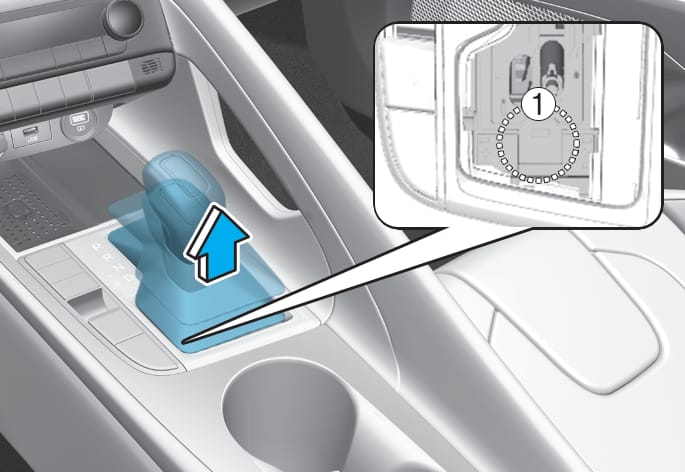
If the shift lever cannot be moved from the P (Park) into R (Reverse) with the brake pedal depressed then:
OCN7N060011L
-
Place the ignition switch in the LOCK/OFF position
-
Apply the parking brake.
-
Carefully remove the shift lever boots.
-
Move the shift lever while holding the release button (1) with a tool (e.g. flathead screw-driver).
If you need to use the shift lock release, have the vehicle inspected by an authorized HYUNDAI dealer immediately.
Be careful not to damage the trim around the shift lever while removing the shift lever boots.
The ignition key cannot be removed unless the shift lever is in the P (Park) position.