Intelligent Variable Transmission operation
The IVT has no actual fixed gears. The varying gear ratios are selected automatically, depending on the position of the shift lever, vehicle's speed and position of the accelerator pedal.
The indicator on the instrument cluster the shift lever position when the ignition switch is in the ON position.
To reduce the risk of serious injury or death:
-
Always check the surrounding areas near your vehicle for people, especially children, before shifting into D (Drive) or R (Reverse).
-
Before leaving the driver's seat, always make sure the shift lever is in the P (Park) position, then apply the parking brake, and place the ignition switch in the LOCK/OFF position. Unexpected and sudden vehicle movement may occur if these precautions are not followed.
-
Do not use engine braking (using the manual shift mode to shift from a higher gear to a lower gear) on slippery roads. The vehicle may lose traction with the roadway, resulting in a collision.
Always come to a complete stop before shifting into P (Park).
To shift from P (Park), depress the brake pedal firmly and make sure your foot is not depressing the accelerator pedal.
If you cannot shift the lever out of P (Park), refer to the "Shift lock release" section in this chapter if equipped with a shift lever.
-
Shifting into P (Park) while the vehicle is moving may cause you to lose control of the vehicle.
-
After the vehicle has stopped, always make sure the shift lever is in P (Park), apply the parking brake, and turn the engine off.
-
When parking on an incline, shift the gear to P (Park), apply the parking brake, and turn the wheels toward the curb to prevent the vehicle from rolling downhill.
-
Do not use the P (Park) position instead of the parking brake.
The RPM (revolution per minute) may increase or decrease when performing the IVT self-diagnosis.
Use this position to drive the vehicle backward.
Always come to a complete stop before shifting into or out of R (Reverse) to prevent damaging the transmission.
The wheels and transmission are not engaged.
Use N (Neutral) if you need to restart a stalled engine, or if it is necessary to stop with the engine ON. Shift into P (Park) if you need to leave your vehicle for any reason.
Always depress the brake pedal when you are shifting from N (Neutral) to another gear.
-
Do not shift into gear unless your foot is firmly on the brake pedal.
-
Do not shift gears with the accelerator pedal depressed. Wait until the engine RPM is normal. The vehicle may suddenly move if you shift gears and release the brake pedal when the RPM is high.
The transmission automatically shifts to the optimal gear ratio, providing the best fuel economy and power.
Shift to D (Drive) while depressing the brake pedal with the engine ON. Then release the brake pedal and depress the accelerator pedal.
For extra power when passing another vehicle or driving uphill, depress the accelerator pedal fully. The transmission automatically downshifts to the next lower gear.
The DRIVE MODE switch, located on the shift lever console or on the left side of the dashboard, allows the driver to switch from NORMAL mode to SPORT or SMART mode (if equipped).
For more information, refer to the "Drive mode integrated control system" section in this chapter.
For more information, refer to the "Drive mode integrated control system" section in the complete Owner's Manual.
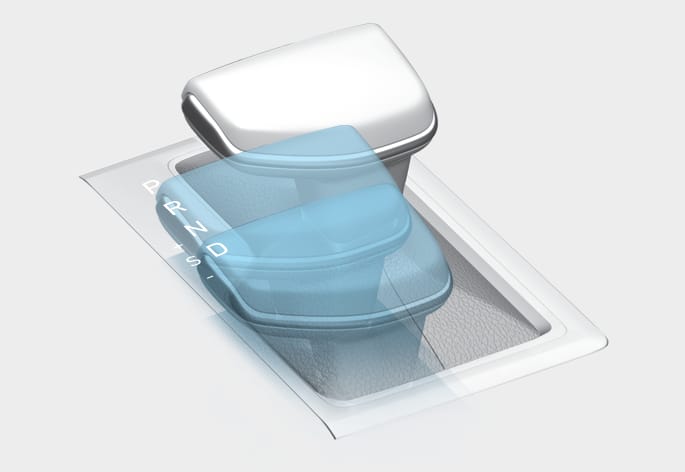
OCN7060007
-
To shift into DS mode, move the shift lever from D (Drive) to the center of the manual shift mode. The engine and transmission control logic is automatically optimized for sporty driving.
-
In DS mode, if you move the shift lever to + (Up) or - (Down), the gear changes to the manual shift mode. If the shift lever is moved back into D (Drive), it changes to D (Drive) and shifts automatically. The vehicle performs according to the mode selected from the drive mode (NORMAL, SPORT, SMART).
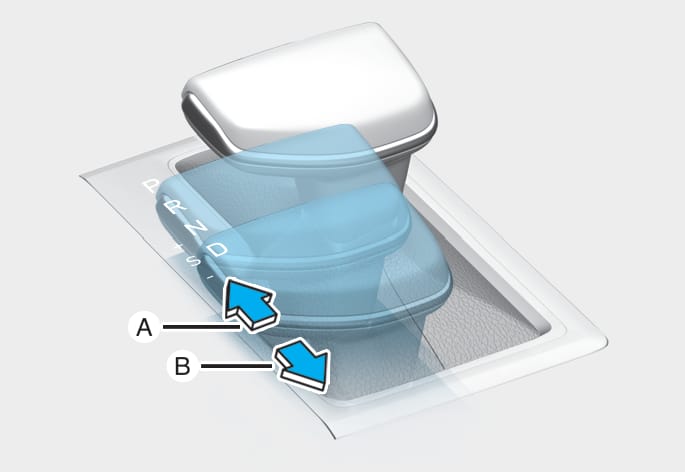
ONX4E060040
- + (Up)
- - (Down)
Whether the vehicle is stationary or moving, the manual shift mode is selected by pushing the shift lever from the D (Drive) position into the manual gate. To return to D (Drive) range operation, push the shift lever back into the main gate.
In manual shift mode, moving the shift lever backward and forward allows you to select the desired range of gears for the current driving conditions.
+ (Up) : Push the lever forward once to shift up one gear.
- (Down) : Pull the lever backwards once to shift down one gear.
-
Downshifts are made automatically when the vehicle slows down.
-
When the engine rpm approaches the red zone, the transmission upshifts automatically.
-
If the driver pushes the lever to + (Up) or - (Down), the transmission may not shift if the next gear is outside of the allowable engine RPM range.
For your safety, the IVT has a shift lock system that prevents the transmission from shifting P (Park) into R (Reverse) unless the brake pedal is depressed.
To shift the transmission from P (Park) into R (Reverse):
-
Depress and hold the brake pedal.
-
Start the engine or place the ignition switch in the ON position.
-
Depress the brake pedal. press the shift release button, and put the gear in R (Reverse).
If the shift lever cannot be moved from the P (Park) into R (Reverse) with the brake pedal depressed then:
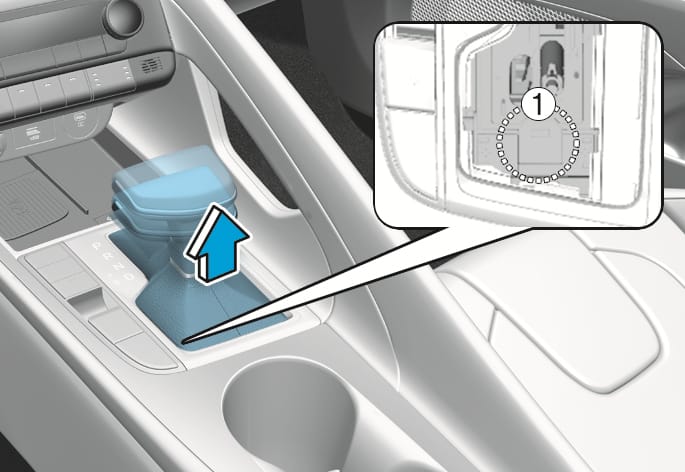
OCN7H063004
-
Place the ignition switch in the LOCK/OFF position.
-
Apply the parking brake.
-
Carefully remove the shift lever boots.
-
Move the shift lever while holding the release button (1) with a tool (e.g. flathead screw-driver).
If you need to use the shift lock release, have the vehicle inspected by an authorized HYUNDAI dealer immediately.
Be careful not to damage the trim around the shift lever while removing the shift lever boots.
The ignition key cannot be removed unless the shift lever is in the P (Park) position.